Check-in June 16, 2025; 2:02 UTC

Current Position: 18 43.423’S 174 06.034’W; Local Timezone: UTC+23; SOG: 0 kt COG: N/A; TWS: 4 kt; TWD: 172; Distance to Waypoint (Vaka’eitu): At Anchor; Total Miles Sailed: 5761 nm;
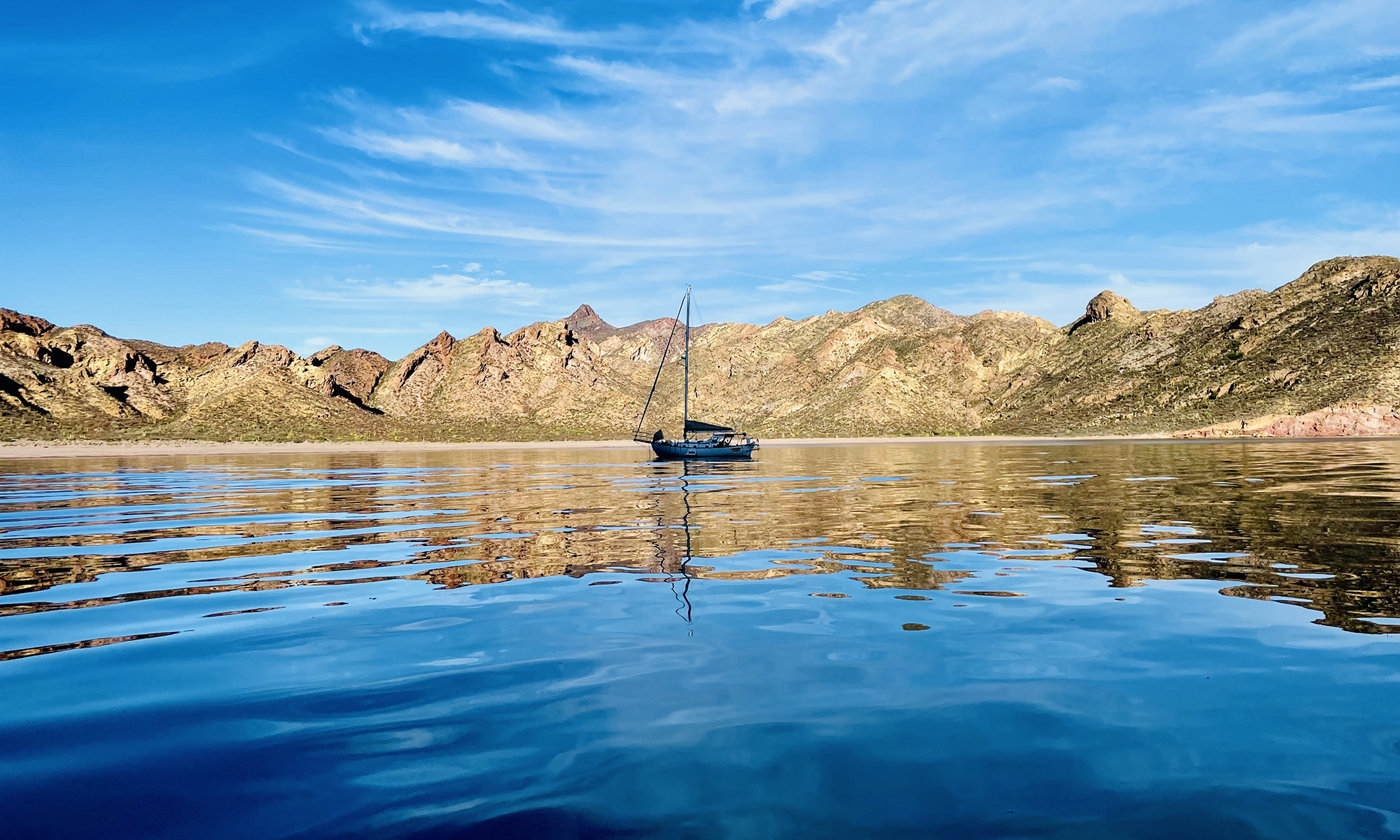
Comments: The wind slowed down a bit yesterday afternoon, so I could mount the outboard on the dinghy and take a Quick Look around. In the immediate vicinity of the anchorage, all the coral appears to be dead. I took a ride over to the place they call the “Coral Garden” at low tide, which was 3:55. There were patches of live coral exposed in the barrier reef, some interesting blue starfish, and a few fish. When I returned to the boat, it was 4:00, about low tide. The boat was in 22’ of water and the anchor appeared to be holding. There is spotty cell service here. It fades in and out. There is one family inhabiting the island. I sometimes hear children playing. The hull of a small boat, it looks like a sailboat that has been demasted, perhaps 25’ long, sitting in its side on the shore. By 17:00, there was almost no wind and the waves had calmed down. I had gotten some provisions from a restaurant on Vava’u called the Tropicana Cafe, and I tried a prepared meal, Chicken Balty Curry. It was very good with rice. I am going to get a half dozen of the meals for the passage. I fell asleep early, about 19:00, and woke up about 2:00. I was being bitten by mosquitoes. I closed up the portholes and put the screen in the companionway. I was awake about 2h, then fell back asleep until dawn, 6:50. There was zero wind and the water was glassy smooth. I tried the yogurt and muesli I got from the Tropicana Cafe. Both were very good. I will get some more before the passage to Vanuatu. As I was getting ready to to some snorkeling, a man on the beach called to me and asked if I would come ashore. David is the grandfather of a four-generation family, the only inhabitants of Vaka’eitu. He asked if I would take his two grandsons to school on Nuapapu Island, about 20m away by fast dinghy. His outboard was out of service. I agreed. The dinghy was filled with bananas and two large bowls of bread and custard. We were met at the dock by the boy’s mother. I returned to Vaka’eitu and did some snorkeling. There was some live coral and unusual spider conch shells with blue coloring. After fixing lunch (prosciutto tomato, and bok choy on sourdough), I slept a good part of the afternoon. When I woke up, there were two more boats anchored. I tried to visit the island where there is the remains of an old jetty and a trail that leads to an abandoned lodge. The jetty was there and remains of a trail, but after wondering around in the jungle for a bit, I did not find any structures. When I came back to the shore, three catamarans had joined the party, making six boats in addition to mine.

Check-in June 15, 2025; 0:31 UTC

Current Position: 18 43.423’S 174 06.034’W; Local Timezone: UTC+23; SOG: 0 kt COG: N/A; TWS: 15 kt; TWD: 57; Distance to Waypoint (Vaka’eitu): At Anchor; Total Miles Sailed: 5761 nm;
Comments: I got up at 6:00, had tea in the cockpit, then started getting the boat ready to move to Vaka’eitu (bringing the dinghy aboard, etc.). I unhooked from the mooring at 8:50. The process was made simpler because I threaded a “release line” through the mooring in advance, just a separate line that I can use to pull the boat forward to retrieve the bridle. When I am ready, I just need to untie one end of the release line and it unthreads from the ball … it takes seconds. Since I was motoring, I ran the watermaker. I arrived at Vaka’eitu about 11:30. It was about a 11 nm journey, and involved a lot of weaving around coral reefs. It took me almost 30m to anchor. I was not satisfied with the first two placements, the wind moved me into shallow water. Finally, I dropped the anchor in sand at 40’ and floated part of the chain (to avoid getting entangled in boomies). The waves are crashing over the reefs. It is going to be fun to explore this place. I am looking forward to trying out the hookah system. By 1:00, wind and waves we’re building from the E. The anchorage does not offer a lot of protection as both wrap around. It is a bit concerning because I am effectively on the windward side of the island. I set an anchor drag alarm and will keep careful watch for a couple of hours. The wind is supposed to become lite and variable by tomorrow morning, then back to the N and eventually to the W by Tuesday. This may not be an acceptable anchorage by then. It is too rolly to lower the outboard, so I will stay on the boat today. While I was the only boat here when ai arrived another sailboat arrived about 13:00 and anchored behind a small island out of the wind. However, they are upwind from a major, dangerous-looking reef, so I don’t think I’d trade places with them. I can see another sailboat in the distance, almost certainly headed here, because this is effectively a box canyon.

Check-in June 14, 2025; 2:12 UTC

Current Position: 18 39.529’S 173 59.003’W; Local Timezone: UTC+23; SOG: 0 kt COG: N/A; TWS: 11 kt; TWD: 160; Distance to Waypoint (Vava’u): At Anchor; Total Miles Sailed: 5750 nm;
Comments: I have been provisioning and preparing the boat most of the day. I plan to leave in the morning and explore some of the other islands, starting with Vaka’eitu. I expect to return to Vava’u on Thursday to provision for the passage to Vanuatu beginning Friday.

Check-in June 13, 2025; 2:00 UTC

Current Position: 18 39.529’S 173 59.003’W; Local Timezone: UTC+23; SOG: 0 kt COG: N/A; TWS: 11 kt; TWD: 160; Distance to Waypoint (Vava’u): At Anchor; Total Miles Sailed: 5750 nm;
Comments: I woke up this morning and there was zero wind. The water in the harbor was like glass. The lack of motion actually woke me up. My punch list of things I need to do in Tonga is growing short. The weather to Vanuatu is looking sporty, with sustained winds at times in the mid 20s and gusts to the mid 30s. Those conditions could be rough on my foresail, so I want to rig my storm staysail today. I have never had it aloft, so I need to work out the sheets and possible a pendent to get it over the rib. I took advantage of the calm to raise and inspect the mainsail. I also looked into putting in the third reef. It would require putting in a couple of reinforced grommets. I raised the storm staysail. I needed a pendent for the storm staysail which I made out of 1/4” Dyneema with anti chafing tubing at the eyelets. I rigged it with only one sheet as I suspect I will not be doing much tacking when I use it. I had the laundry done, started doing some provisioning, and sent the Advance Notice of Arrival to Vanuatu.

Check-in June 12, 2025; 1:12 UTC

Current Position: 18 39.529’S 173 59.003’W; Local Timezone: UTC+23; SOG: 0 kt COG: N/A; TWS: 11 kt; TWD: 160; Distance to Waypoint (Vava’u): At Anchor; Total Miles Sailed: 5750 nm;
Comments: I started repair of the toe rail beneath the port stanchion that supports the 6 hp outboard. A chunk of wood came out and the underlying wood did not support one of the screws. I replaced the screw with one much longer and patched the wood with epoxy and West Systems 407 low-density filler. I also repaired several other stanchions either by putting in longer wood screws or drilling through and using a bolt. I finished making my new fishing gaff. I sorted through some longer-term provisions and restocked my pantry with non-perishables. I spent the rest of my day researching my route and exploring the formalities. I updated the website with my new itinerary, which involved skipping Fiji, and Going to a different port in Vanuatu. I considered the possibility of skipping Tuesday Island, but that would mean a nearly 300 nm trip to Darwin. I also considered a stop in Indonesia, but there were security and timing issues, so after Darwin I will go to Christmas Island. I looked at the longer-term weather forecast. I am going to try to finish my work on the boat by Saturday, then spend a few days exploring the islands, before return on Wednesday overnight. I will probably check-out Thursday morning.
Sent from my iPhone

Check-in June 11, 2025; 1:44 UTC

Current Position: 18 39.529’S 173 59.003’W; Local Timezone: UTC+23; SOG: 0 kt COG: N/A; TWS: 11 kt; TWD: 160; Distance to Waypoint (Vava’u): At Anchor; Total Miles Sailed: 5750 nm;
Comments: I am going to try to fix the boom today. I started by swinging the boom to the starboard and lashing it so it was not over the solar panels. I then lashed the mainsail to itself (not the boom), released the clew and the tack, and lifted it out of the way (up the track), before lashing it to the mast (to reduce the windage). I unbuckled the bottom of the stack pack and folded the sides up so I could see what I was doing. I secured the topping lift so the far end of the boom was about level and released the pneumatic boom vang. I tied a line about two-thirds down the boom, ran it through a block I had attached to the deck and back to a winch (so I could keep the boom from swinging forward). I ran the spinnaker halyard around and attached it to a loop that was near where the boom vane attaches so I could lift/lower the near end of the boom. At that point I removed the remaining three screws on the side of the boom and used the winch to separate the boom from the gooseneck plate. Once inside I discovered my plan to put a threaded rod through the hole that was stripped was not going to work because there is a tube welded inside for the gooseneck that is in the way. However, I decided to tap the stripped hole to 10 mm. I did not have a 10 mm tap and I didn’t want to spend the $150 to by a set, so I took the 10 mm 316 stainless rod and fashioned a tap, which wouldn’t work for hardened steel but was just fine for aluminum. The thread is not complete because of the rounding of the hole when it was stripped, but I believe there is enough thread to hold. All of the 5/16” screws were replaced with 5/16” bolts with lock washers, except for the one that was stripped, which was replaced with a 10 mm bolt and lock washer. Before I put everything back together, I searched for a 7/16” bolt (I have a 7/26” tap), but could not find one. I have 1/2” bolts and taps, but did not want to remove that much material from the boom. I had to be careful tightening down the bolts because there is not much aluminum in the female thread. In fact, when putting in the second bolt in on the port side, the same side as the stripped thread, I found it too was stripped. It tried putting in a 10 mm bolt, but it did not feel secure, so I put a 10 mm rod through the boom and used nuts to secure it. That certainly is not going to fail. Putting the boom back on the gooseneck was a challenge because of the weight and forces involved and the fact the alignment had to be perfect to pass the pin through it. I ended up using the windlass capstan to drag the boom forward to align the holes. I could tell by the forces on the rope I was using that I could never have done it by hand. The rest of the job was easy, just putting everything back together. What I find during jobs like this is you take one step forward and two steps back. I discovered a zipper on the sail pack needs to be sewn and I saw one screw was missing, one had the head broken off and several others were loose or stripped on the boom vang. There was nothing I could do about the screw that was broken off, by the three 1/4” screws that were stripped were tapped to 5/16” and replaced with bolts and lock washers.

Boom Repaired

I was horrified during my passage from Tahiti to Tonga that the plate that holds the gooseneck onto the boom was missing a screw (it had stripped out) and two if the remaining three screws were very loose. Furthermore, the gooseneck itself was missing a screw, but there was nothing I could do about it while at sea because the screw had a nut on the inside of the boom that had fallen off. The outcome could have been catastrophic had the plate broken free. I tightened the loose screws and monitored the situation for the remainder of the passage.

I have been in Tonga several days now and have managed to find the parts to fix the boom. I started by swinging the boom to the starboard and lashing it so it was not over the solar panels. I then lashed the mainsail to itself (not the boom), released the clew and the tack, and lifted it out of the way (up the track), before lashing it to the mast (to reduce the windage). I unbuckled the bottom of the stack pack and folded the port side up so I could see what I was doing. I secured the topping lift so the far end of the boom was about level and released the pneumatic boom vang. I tied a line about two-thirds down the boom, ran it through a block I had attached to the deck and back to a winch (so I could keep the boom from swinging forward). I ran the spinnaker halyard around and attached it to a loop that was near where the boom vane attaches so I could lift/lower the near end of the boom. At that point I removed the remaining three screws on the side of the boom and used the winch to separate the boom from the gooseneck plate.

Once inside I discovered my plan to put a threaded rod through the hole that was stripped was not going to work because there is a tube welded inside for the gooseneck that is in the way. However, I decided to tap the stripped hole to 10 mm. I did not have a 10 mm tap and I didn’t want to spend the $150 to by a set, so I took the 10 mm 316 stainless rod and fashioned a tap, which wouldn’t work for hardened steel but was just fine for aluminum. The thread is not complete because of the rounding of the hole when it was stripped, but I believe there is enough thread to hold. All of the 5/16” screws were replaced with 5/16” bolts with lock washers, except for the stripped, which was replaced with a 10 mm bolt and lock washer. Before I put everything back together, I searched for a 7/16” bolt (I have a 7/26” tap), but could not find one. I have 1/2” bolts and taps, but did not want to remove that much material from the boom. I had to be careful tightening down the bolts because there is not much aluminum in the female thread. In fact, when putting in the second bolt in on the port side, the same side as the stripped thread, I found it too was stripped. I tried putting in a 10 mm bolt, but it did not feel secure, so I put a 10 mm rod through the boom and used nuts to secure it. That certainly is not going to fail.

Putting the boom back on the gooseneck was a challenge because of the weight and forces involved and the fact the alignment had to be perfect to pass the pin through it. I ended up using the windlass capstan to drag the boom forward to align the holes. I could tell by the forces on the rope I was using that I could never have done it by hand. The rest of the job was easy, just putting everything back together. What I find during jobs like this is you take one step forward and two steps back. I discovered a zipper on the sail pack needs to be sewn and I saw one screw was missing, one had the head broken off and several others were loose or stripped on the boom vang. 

Check-in June 10, 2025; 01:24 UTC

Current Position: 18 39.529’S 173 59.003’W; Local Timezone: UTC+23; SOG: 0 kt COG: N/A; TWS: 11 kt; TWD: 160; Distance to Waypoint (Vava’u): At Anchor; Total Miles Sailed: 5750 nm;
Comments: In addition to surveying the entire boat (every nut and bolt), my priorities for repairs are 1) reinforce the stern pulpit, 2) make a repair to the boom where the fourth bolt is stripped, 3) get my LP tank filled. A Quick Look around this morning and I found another screw missing, this time from the gooseneck bracket itself. This is very serious. This morning, I am going to the Tropicana Cafe, where they are supposed to fill LP bottles on Tuesdays at 9:00. I have partially used two of the three bottles. The first one developed a leak that I need to fix and the other I have used more.The weight of the the first bottle is 19.6 lb and the weight of the second 14.0. The tare weight is 9.9 and the full weight is 23.6 lbs, so I have used 23.6-19.6=4 lbs of fuel in the first and 23.6-14.9=9.6 lbs of the second for a total of 9.6+4=13.6 lb. The capacity is 23.6-9.9=13.7 lbs, so I have only used one-third of my LP fuel in three months. Although there is quite a bit of fuel remaining in the tanks, this is one of the few places that use LP and has the adapters in the South Pacific, so I am going to get them filled. I arrived at Cafe Tropicana right at 9:00. There was already a bunch of bottles waiting to be filled. I was told they’d be ready by noon. I took the opportunity to have breakfast. I asked about a 10mm tap (to repair the boom) and was sent on a 20m walk to a hardware store who had a tap and die set for $150. I decided to hold out to see if I could find an alternative solution. The store did have a good handle for the gaff so was planning to make, so I got it, even though it was $25. I walked to the marine chandlery and I was shocked to see 316 SS threaded rod immediately as you walk through the door. That was exactly what I need to fix the boom. I also bought the nuts and washers. As I was preparing to pay, I asked if they happen to sell gaffs. The lady apologized and said no, just the heads, and then she produced a sharpened and bent piece of stainless rod that was exactly what I had been planning to fabricate from some rod I had onboard. Score! I took my haul to the boat and returned at noon to the Cafe Tropicana to fetch my LP tanks, where I was told they couldn’t fill them. Some research on the internet taught me that Mexico gets almost all of its LP gas from the US, and the US refines its LP gas so that it is almost pure propane. The LP gas in Tonga is a mixture of propane and butane. Because the former is more volatile that the latter, Tongan LP gas cannot be condensed into a tank that has US LP gas in it. Rather than empty one of the tanks, I decided to continue using it expecting it to last until Thursday Island. On a sour note, I have come to realize that that the plate at the end of the boom to which the gooseneck is attached is bolted from the inside, which means the boom will have to be taken apart to do a repair. This is going to be a big job. I am working on a hydraulic system to support the boom so I don’t need to remove the mainsail. I will have to undertake this project early in the morning, because high winds typically develop in the afternoon. This may be for the best, because I can inspect inside the boom to see if there has been any damage after sailing with only two of the six screws (one lose and one missing on the front and one missing and one loose of the four on the side) firmly attached to the gooseneck plate.

LP Tanks from Mexico Should Not Last As Long As LP Tanks From Tonga

I took two LP gas bottles to be refilled today in Tonga and was told, after they tried, that they could not fill them. The tanks were previously filled in Mexico. Some research on the internet taught me that Mexico gets almost all of its LP gas from the US, and the US refines its LP gas so that it is almost pure propane. The LP gas in Tonga is a mixture of propane and butane. Because the former is more volatile than the latter, Tongan LP gas cannot be condensed into a tank that has US LP gas in it. It is also noteworthy that propane burns hotter than butane on a per molecule basis. So the question is, can you expect a tank of liquid propane to last longer than a tank of butane (or propane/butane mixture)? The heat of combustion is related to the H/C ratio for hydrocarbons and propane has a higher H/C ratio than butane. The formulas for combustion are:

C3H8 + 8 O2 → 4 H2O + 3 CO2

2 C4H10 + 13 O2 → 10 H2O + 8 CO2

The additional heat for propane vs. butane per molecule is given roughly by:

(8/3)/(10/4)‎ = 1.0667

The heat of combustion (at standard temperature and pressure) of propane is 2220.1 kJ/mol and for butane is 2877.5 kJ/mol. The density of liquid propane at room temperature (25°C) is approximately 0.493 grams per cubic centimeter.  For butane it is 0.599 g/cm3. So if we assume are tank is 1 cm3 (does not matter what size it is for the calculation), propane produces:

0.493 g/cm3 X (1/44.10 g/mol) X 2229.1 kJ/mol = 24.92 kJ/cm3

Butane produces:

0.599 g/cm3 X 58.12 g/mol X 2877.5 kJ/mol = 29.66 kJ/cm3

So, for a given volume of liquid gas at room temperature, butane produces more energy than propane (29.66/24.92=1.19, about 20%). While propane has a higher calorific value per unit of mass, butane’s higher specific gravity (density) means it packs more mass into the same volume, resulting in a higher overall energy output per volume.

There is a potential issue regarding mixtures of gases (if we are not dealing with pure propane or butane), namely if the molecules interact in some way, but hydrocarbons are generally considered to be “ideal gases” (and ideal liquids).

Bottom line … same-sized LP tanks from Mexico should not last as long as LP tanks from Tonga.

You might ask why there are different formulas for LP gas. Propane is more volatile than butane, so it is more suitable for the cooler climates. Tonga does not have to worry about vaporizing butane.

Check-in June 9, 2025; 1:16 UTC

Current Position: 18 39.529’S 173 59.003’W; Local Timezone: UTC+23; SOG: 0 kt COG: N/A; TWS: 11 kt; TWD: 160; Distance to Waypoint (Vava’u): At Anchor; Total Miles Sailed: 5750 nm;
Comments: I was really reluctant to move the boat to the customs dock. I have a good mooring and it is always a challenge to grab one by yourself without dinging one of the mega yachts you’re surrounded with. Hopefully it will still be here when I return. Ideally, I am suppose to visit the dock at high tide because it is a commercial dock, not really built for small boats, and the tide here can be six feet. Unfortunately, high tide is at 5:00 AM and 5:00 PM, outside the working hours of the officials. Also unfortunate is several other boats came in over the weekend, a cargo ship came in overnight and is occupying most of the dock, and customs was closed yesterday so all the boats that came in over the weekend are queued up for check-in. I see one has been circling by the dock for an hour. To make matters worse, the wind is picking up, making it impossible to stay still without being moored. It looked like there was room at the end of the dock, but then I remembered that there is a wreck there. The ship left about 11:00, making room for myself and one other boat (Danza, the boat that passed me in the last night of the passage) at the commercial dock, which is about three times taller than the fisherman’s dock and is covered in barnacles. I dropped a second float and left my bridle to “mark my mooring”. Danza, a 60’ ketch, went first and I rafted with her, making my job easier as her whole crew helped me tie up. I was visited first by customs, who gave me a stack of papers to fill out. Quarantine visited next, asked about my provisions and if I had any animals aboard. Health visit next and the official certified me healthy. I was then sent to an ATM to withdraw Tongan currency, 22 TON for Quarantine and 109 TON for Health (about $60 total USD). Customs then returned, examined my paperwork and asked a few questions. I was surprised that he took the Zarpe from Tahiti. I took a photo before he did. None of the officials went below deck, and all three were friendly and very professional. By 14:30, I was back on the mooring ball. The yellow Q flag came down. Aegir-Ran will be at home on the mooring ball for a week while I make repairs and provision. I will then explore some other anchorages before I return to check out. I am not going to check out in a Monday though. I am going to my to celebrate by putting the dinghy in the water and go into town for a meal.