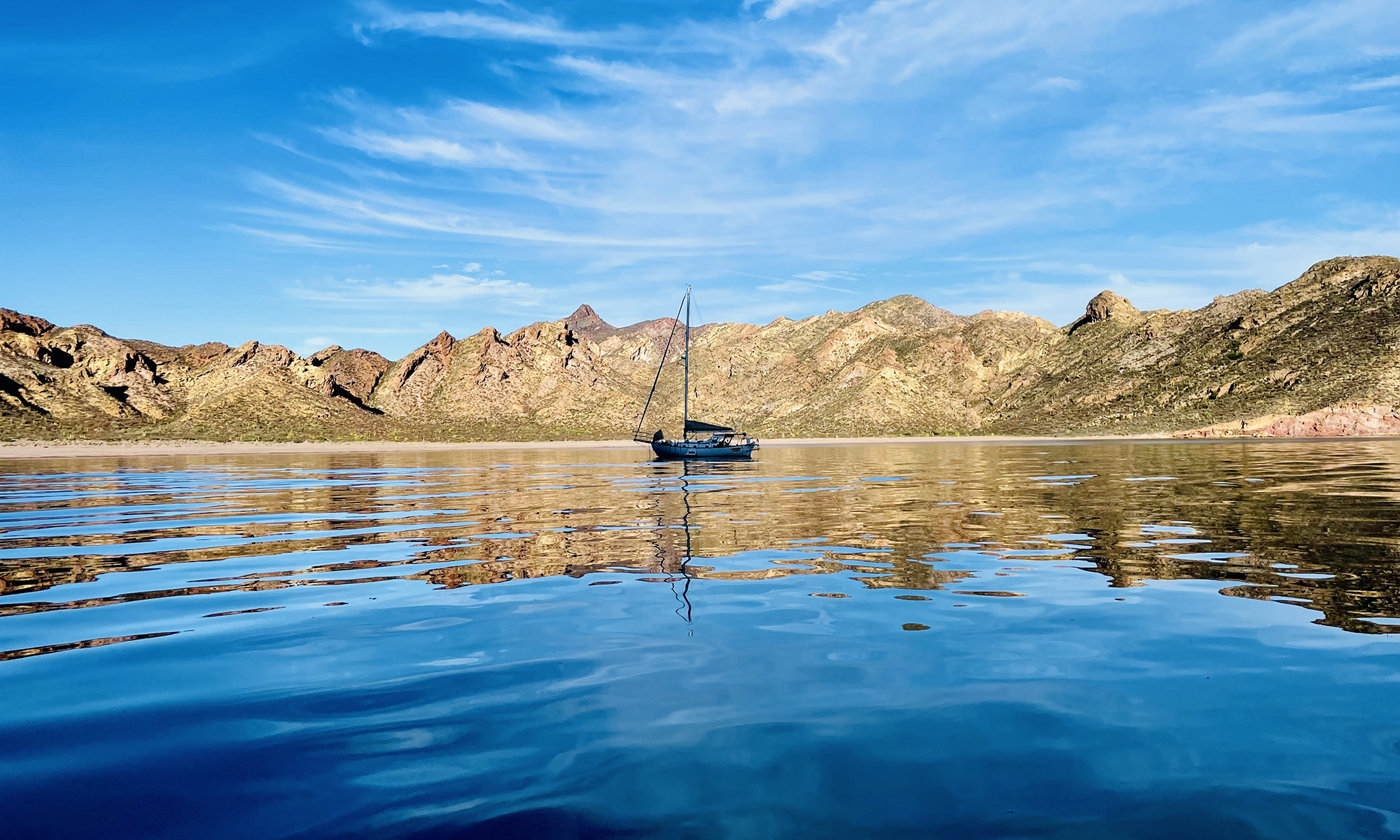
Since leaving Cabo San Lucas, Mexico on March 25, almost five months ago, I have sailed in the Pacific Ocean. South of Australia, the boundary between the Pacific Ocean and Indian Ocean is generally defined by a line extending from South East Cape, Tasmania, along the 147°E meridian. North of Australia, the border is less clearly defined, but often runs from Cape Londonderry, Australia, across the Timor Sea, along the southern shores of Java, and through the Sunda Strait. Cape Londonderry is located at 13°44′59″S 126°55′02″E. I sailed west of the Cape last night and am currently at 126°49′E at sunrise on August 15. The Indian Ocean will be a challenge to cross, without as many places to stop and not nearly the resources to provision and make repairs. it will take about three and a half months to reach Cape Town, South Africa, where I will enter the Atlantic Ocean. The most challenging stretch will be between the Cocos-Keelings and Richard’s Bay, South Africa. There are basically two routes, directly south, east of Madagascar via Mauritius, and west of Madagascar, via the Mozambique Channel. Each has advantages and disadvantages, but ultimately the course will be determined by the weather.
Check-in August 14, 2025; 6:00 UTC
Current Position: 12 16.771’S 127 17.899’E; Local Timezone: UTC+8 SOG: 1.2; COG: 310; TWS: 6 kt; TWD: 91; Distance to Waypoint (Ashmore Reef, 269): 357; Total Miles Sailed: 9738 nm; Engine Hours: 229; Estimate Fuel: 60+11+50;
Comments: Sunset was at 17:22. Remarkable, the wind has been going strong all day and it is still blowing 15 kt with a SOG of 4 that is about to be assisted by the current. This was not predicted by any of the eight weather models. The GRIB was 14h old, so I downloaded new ones. The forecast has once more completely changed. Double digit winds are expected overnight with sustained winds in the 20s all day tomorrow, starting out from the SE, then backing to the E later in the day. The wind strengths are different for each model, but they all forecast winds from the NE to SE. It is 18:15 and for some reason the waves have become higher, causing the boat to roll and the slatting of the sails. I switched from the TillerPilot to the windvane because it looks like there is going to be enough wind. I also set a more southerly course in an effort to take advantage of what wind I have and to try to stop the slatting of the sails. Also, if the wind turns E, I will probably be tacking. I went to sleep at 18:30. The wind was still blowing 15. At a 2h alarm, not much had changed. I set another 2h alarm and woke up just before it went off at 22:30. The wind was variable 3-7 kt, too slow to allow the windvane to work and the boat was drifting in a 1.5 kt current that was generally towards the waypoint. However, the boat was not pointed in that direction. I switched over to the TillerPilot and set a course for 260, close to the waypoint at 270, and the boat picked up another 1 kt speed, aided by the light wind. The boat had travelled more than 80 nm in the past 18h (4.5 kt avg.), the best so far in this passage. At 23:30 the alarm went off on the TillerPilot. The wind is too light and the direction of is variable so there is no way way to steer. I heave to snd let the current carry me, setting an alarm for an hour to see if the situation changes, although I suspect it will not until dawn. A nearby current monitor suggests the current will flow in the general direction of the waypoint for about 2h. At 2:30 a 0.6 kt current was pushing me E with glassy water and zero wind. The current will have veered to the S by 7:00. At 4:30 I was awaken by a gust. The wind was blowing 4 kt with an occasional gust of 7.the boat had gone around in circles for 5.5h, driven only by the currents, and ending up where the wind had stopped blowing early in the evening. I set the sails and managed 0.3 kt in more or less the right direction, against the currents. At least I wasn’t loosing ground. Sunrise should be about 5:45, about an hour from now. I downloaded new GRIBs. They were self-consistent, all predicting single-digit wind the next 24h with gusts of 12 or so. This is in sharp contrast with the forecast from last night, which predicted winds in the 20s. Basically, the forecasts are useless in the Timor Sea. As the horizon starts to light up, I can see a few clouds, the first since leaving Darwin. At 5:25, I have 6 kt of wind from the S giving me a boat speed of 1.5 kt against a current of 0.5 kt for a SOG of 1 kt. I start to see some gusts at thr sunrise of 9 kt. Once the sun was up, the gusts stopped and the wind blew 5-6, barely enough to maintain a course. 272 nm to Ashmore. Looks like it is going to be a crawl today. I laid down for a rest and woke up at 8:15. The wind had increased to 9 kt and backed to 60, so I tacked and set a course of 280 (waypoint at 270). I had been averaging 1.3 kt and now averaged 2.1. The starboard tack also exposed the solar panels. I note the wind speed change and direction were predicted by all of the models (although they predicted about 75 degrees). I will note that the current is starting to help me and is expected to do so until about 13:00 (next 5h). At 9:00, three dolphins started following the boat, about 100’ back, and did so for about 30m. The color of the water has changed … it is more blue. The depth is now 350’. I was contacted by the ABF again via VHF at 9:20, this time apparently a shore radio. They asked the usual questions, but also wanted to know my ETA for Christmas Island. I told them 3-4 weeks. At 9:26 an ABF aircraft buzzed me, so perhaps it was the aircraft that called me. There is only 4 kt of wind, hardly enough to steer. The boat speed is less than 1 kt, but the SOG is over 2 because of a favorable 1.2 kt current. I was about to shake out the second reef, but the lain is luff as is (the wind is insufficient to fill it), so I changed my mind. Most of the propulsion is probably coming from the jib anyway, and it is already slatting when the boat rolls. I’d probably do better to drop the main all together and run with the jib. These are almost good conditions for the asymm, if only I had a little more air. A column of dead air shoots straight up from Cape Londonderry, and is about 90 nm wide. No wind is expected there until Sunday. It looks like I could finish off the last 250 nm Saturday-Monday. I believe I would rather do that rather than burn 25 gal of fuel. I’ll just enjoy the smooth water and laid-back sailing. I might put up the asymm, but I don’t like to fly it at night and it hardly seems worth it for 5h this afternoon. The distance sailed towards Ashmore Reef in the last 23h was 300-256=44 nm. The total distance sailed was 9738-9714=24 nm (24/23=1.0 kt avg.). Note this discrepancy is due to the current.
Comments: Sunset was at 17:22. Remarkable, the wind has been going strong all day and it is still blowing 15 kt with a SOG of 4 that is about to be assisted by the current. This was not predicted by any of the eight weather models. The GRIB was 14h old, so I downloaded new ones. The forecast has once more completely changed. Double digit winds are expected overnight with sustained winds in the 20s all day tomorrow, starting out from the SE, then backing to the E later in the day. The wind strengths are different for each model, but they all forecast winds from the NE to SE. It is 18:15 and for some reason the waves have become higher, causing the boat to roll and the slatting of the sails. I switched from the TillerPilot to the windvane because it looks like there is going to be enough wind. I also set a more southerly course in an effort to take advantage of what wind I have and to try to stop the slatting of the sails. Also, if the wind turns E, I will probably be tacking. I went to sleep at 18:30. The wind was still blowing 15. At a 2h alarm, not much had changed. I set another 2h alarm and woke up just before it went off at 22:30. The wind was variable 3-7 kt, too slow to allow the windvane to work and the boat was drifting in a 1.5 kt current that was generally towards the waypoint. However, the boat was not pointed in that direction. I switched over to the TillerPilot and set a course for 260, close to the waypoint at 270, and the boat picked up another 1 kt speed, aided by the light wind. The boat had travelled more than 80 nm in the past 18h (4.5 kt avg.), the best so far in this passage. At 23:30 the alarm went off on the TillerPilot. The wind is too light and the direction of is variable so there is no way way to steer. I heave to snd let the current carry me, setting an alarm for an hour to see if the situation changes, although I suspect it will not until dawn. A nearby current monitor suggests the current will flow in the general direction of the waypoint for about 2h. At 2:30 a 0.6 kt current was pushing me E with glassy water and zero wind. The current will have veered to the S by 7:00. At 4:30 I was awaken by a gust. The wind was blowing 4 kt with an occasional gust of 7.the boat had gone around in circles for 5.5h, driven only by the currents, and ending up where the wind had stopped blowing early in the evening. I set the sails and managed 0.3 kt in more or less the right direction, against the currents. At least I wasn’t loosing ground. Sunrise should be about 5:45, about an hour from now. I downloaded new GRIBs. They were self-consistent, all predicting single-digit wind the next 24h with gusts of 12 or so. This is in sharp contrast with the forecast from last night, which predicted winds in the 20s. Basically, the forecasts are useless in the Timor Sea. As the horizon starts to light up, I can see a few clouds, the first since leaving Darwin. At 5:25, I have 6 kt of wind from the S giving me a boat speed of 1.5 kt against a current of 0.5 kt for a SOG of 1 kt. I start to see some gusts at thr sunrise of 9 kt. Once the sun was up, the gusts stopped and the wind blew 5-6, barely enough to maintain a course. 272 nm to Ashmore. Looks like it is going to be a crawl today. I laid down for a rest and woke up at 8:15. The wind had increased to 9 kt and backed to 60, so I tacked and set a course of 280 (waypoint at 270). I had been averaging 1.3 kt and now averaged 2.1. The starboard tack also exposed the solar panels. I note the wind speed change and direction were predicted by all of the models (although they predicted about 75 degrees). I will note that the current is starting to help me and is expected to do so until about 13:00 (next 5h). At 9:00, three dolphins started following the boat, about 100’ back, and did so for about 30m. The color of the water has changed … it is more blue. The depth is now 350’. I was contacted by the ABF again via VHF at 9:20, this time apparently a shore radio. They asked the usual questions, but also wanted to know my ETA for Christmas Island. I told them 3-4 weeks. At 9:26 an ABF aircraft buzzed me, so perhaps it was the aircraft that called me. There is only 4 kt of wind, hardly enough to steer. The boat speed is less than 1 kt, but the SOG is over 2 because of a favorable 1.2 kt current. I was about to shake out the second reef, but the lain is luff as is (the wind is insufficient to fill it), so I changed my mind. Most of the propulsion is probably coming from the jib anyway, and it is already slatting when the boat rolls. I’d probably do better to drop the main all together and run with the jib. These are almost good conditions for the asymm, if only I had a little more air. A column of dead air shoots straight up from Cape Londonderry, and is about 90 nm wide. No wind is expected there until Sunday. It looks like I could finish off the last 250 nm Saturday-Monday. I believe I would rather do that rather than burn 25 gal of fuel. I’ll just enjoy the smooth water and laid-back sailing. I might put up the asymm, but I don’t like to fly it at night and it hardly seems worth it for 5h this afternoon. The distance sailed towards Ashmore Reef in the last 23h was 300-256=44 nm. The total distance sailed was 9738-9714=24 nm (24/23=1.0 kt avg.). Note this discrepancy is due to the current.
Correction: Check-in August 13, 2025; 7:00 UTC
Current Position: 12 18.893’S 128 03.030’E; Local Timezone: UTC+8 SOG: 4.2; COG: 253; TWS: 16 kt; TWD: 120; Distance to Waypoint (Ashmore Reef, 269): 300; Total Miles Sailed: 9714 nm; Engine Hours: 229; Estimate Fuel: 60+11+50;
Correction: The distance to the waypoint and h to r engine hours are corrected.
Comments: Note, beginning with this report I sm moving to the UTC+8 time zone. It is 17:00, almost dusk, and there is essentially zero wind. I took advantage to properly reef the main and furl in some of the jib, in anticipation of strong winds later tonight. I should start moving again in a couple of hours and start seeing gust of 25-30 after midnight. I will probably need to put a second reef in the main then. The wind is supposed to be from the SE, making progress W towards the waypoint possible. It is 18:00 and I just downloaded new GRIBs. In the 4-5h since doing that last time, the forecast has completely changed. Strong winds are not expected the next couple of days. It looks like very light winds all night. Tomorrow morning looks like this morning, 15 with gusts up to 25 until early afternoon. There is no wind right now, but eventually the light wind should come from the S, so I will set up the sails for that eventuality. It is 18:15 and there is a fishing boat 5 nm off my port bow. I saw its lights while setting the sails and checked the AIS. Looks like we’re going to pass one another port to port in about 20m. By 18:30 the wind was blowing again, 6 kt, enough to drive the boat toward the waypoint at 3 kt with the help of a strong current. I went to sleep at 19:30 with a 2h alarm. At 22:30 the conditions were unchanged. I set the alarm for 2h and at 23:30 they were unchanged (still 3 kt SOG in 6 kt of wind), but I was being pushed a bit N by the current. At 00:30 I was awaken by the sounds of the rigging. A few minutes later the alarm went off on the TillerPilot because the wind had gone to zero and it could no longer maintain the course. I disengaged the TillerPilot, steered in the direction of the current (with the aid of the engine), snd locked off the tiller with a course of 330. The boat was drifting with the 0.7 kt current. The current direction was expected to veer, sending me in the wrong direction without wind, and not come back around until about dawn. I set a 30m alarm and when I woke there was 3-4 kt wind, just enough to make 1 kt against a 0.4 kt current. This continued until about 3:30 when the wind picked up to 7-8 kt from almost due S. I was ably to make 1.5 kt towards the waypoint against a strong 1.5 kt current. I have been following a tug on AIS. It is off my starboard bow about 5 nm and will pass in about 30m. At 4:00 I decided to download a new GRIB as they don’t seem to be reliable more than 6h out in these waters. I also need fresh long-range AIS data. Sure enough, the forecasted wind velocities have been decreased. I can still expect double digits today but in the 15-18 kt range after sunrise. A huge area of dead air is developing in the middle of the Timor Sea. The only wind is close to the coasts (and the shoals). Further, for the first time the models are not consistent, some have me going N and some S. I am going to stick it out in the middle and when I have a good period of light wind I will break out the asymm. Sunrise will be about 5:40. It is 5:00 and the double-digits winds have showed up … 13 kt. Just before sunrise, the winds started to gust to 22, overwhelming the TillerPilot, so I switched to the windvane. The boat is averaging 5 kt with a current on the bean that is driving it somewhat S of the waypoint. At sunrise I am seeing gusts of 27. I suspect these will be short-lived, like yesterday, so I hand-steer through them rather than put a second reef in the main. The 0.7 kt current is veering to align with my course. I am average 5.5 on nearly a run. The short-steep waves developed quickly, within 30m of the 20+ kt winds. I trimmed the jib and am now making over 6 kt during the gusts. It would be nice to chip away at the remaining 345 nm. I’ve only averaged 60 nm/day the two days I have been sailing. At this rate it will take 6 more days to get to the reef. It’s simple … it’s taking twice as long to sail this passage as it usually does because I am only sailing half the day (or less). The sun just peeked over the horizon and I experienced a 32 kt gusts. Finally, at 6:00 I had to put a second reef in. It was blowing 28 consistently with 33 kt gusts. It took me 20m to get the reef completely in … not easy in 30 Kt winds that was made more difficult when the boat kept heaving to. Once in, I saw 6.5-7.5 kt boat speeds in 25-30 kt winds and a 1.3 Kt current. I was soaking wet from the spray and I was particular disappointed that my morning tea had been contaminated with salt water. I am about halfway across the Joseph Bonaparte Gulf, and area of weather disturbance that I believe produces the choppy lumpy seas. The windvane is of course working much better now that the boat is not overpowered. I am even able to enjoy my breakfast of yogurt, muesli, and banana (only one banana left) in the cockpit. As expected, by 7:00 the winds had settled into 18-20 kt with infrequent gusts. Tired from wrestling the tiller and sails, and since there were no vessels in the area, I laid down for a rest. I was only down 30m when the boat jibed, probably because of the changing current. At 11:30 the sailboat Oda suddenly appeared behind me. They were only doing a half kt faster than me and didn’t show up on the long-range AIS maps until about the same time, so I am guessing they had their AIS turned off. They seem to be sailing directly downwind. They passed about 4 nm off my starboard. It is noon. Winds are down to 15 with no gusts. The boat speed is 3.5 and the SOG 4.5, added in part by a 1.5 kt current. I should be able to do better, but the short steep waves and generally confused seas are slowing me down. When the winds are stronger, I can power through the seas, but ai have to sheet the jib now to keep it from slatting violently. I’ve done about 60 nm on since the check-in last night, about 21.5h ago, so it will be another 60-70 nm day, with almost all the miles coming in the morning. The speed of the boat is not proportional to the wind speed. Early in the morning, despite having big, disruptive waves, the boat powers through in the 25 kt wind because there is relatively little slatting. Later in the day, relatively good boat speed is attained because the sea conditions are better and the wind isn’t dumped from the sails every few seconds in 12 kt wind. In between is rough, when the wind is 18 and the seas are still big. The sailing in the middle of the afternoon is most comfortable and efficient. An ABF aircraft contacted me via VHF at 14:00 with the usual questions. I note that the winds are lasting later in the day today compared to yesterday. The SOG was 1.5-2 against a 0.4 kt current. The distance sailed towards Ashmore Reef in the last 24.75h was 375-300=75 nm. The total distance sailed was 9714-9645=69 nm (69/24.75=2.3 kt avg.). Note this discrepancy is due to the current.
Check-in August 13, 2025; 7:00 UTC
Current Position: 12 18.893’S 128 03.030’E; Local Timezone: UTC+8 SOG: 4.2; COG: 253; TWS: 16 kt; TWD: 120; Distance to Waypoint (Ashmore Reef, 269): 375; Total Miles Sailed: 9714 nm; Engine Hours: 300; Estimate Fuel: 60+11+50;
Comments: Note, beginning with this report I sm moving to the UTC+8 time zone. It is 17:00, almost dusk, and there is essentially zero wind. I took advantage to properly reef the main and furl in some of the jib, in anticipation of strong winds later tonight. I should start moving again in a couple of hours and start seeing gust of 25-30 after midnight. I will probably need to put a second reef in the main then. The wind is supposed to be from the SE, making progress W towards the waypoint possible. It is 18:00 and I just downloaded new GRIBs. In the 4-5h since doing that last time, the forecast has completely changed. Strong winds are not expected the next couple of days. It looks like very light winds all night. Tomorrow morning looks like this morning, 15 with gusts up to 25 until early afternoon. There is no wind right now, but eventually the light wind should come from the S, so I will set up the sails for that eventuality. It is 18:15 and there is a fishing boat 5 nm off my port bow. I saw its lights while setting the sails and checked the AIS. Looks like we’re going to pass one another port to port in about 20m. By 18:30 the wind was blowing again, 6 kt, enough to drive the boat toward the waypoint at 3 kt with the help of a strong current. I went to sleep at 19:30 with a 2h alarm. At 22:30 the conditions were unchanged. I set the alarm for 2h and at 23:30 they were unchanged (still 3 kt SOG in 6 kt of wind), but I was being pushed a bit N by the current. At 00:30 I was awaken by the sounds of the rigging. A few minutes later the alarm went off on the TillerPilot because the wind had gone to zero and it could no longer maintain the course. I disengaged the TillerPilot, steered in the direction of the current (with the aid of the engine), snd locked off the tiller with a course of 330. The boat was drifting with the 0.7 kt current. The current direction was expected to veer, sending me in the wrong direction without wind, and not come back around until about dawn. I set a 30m alarm and when I woke there was 3-4 kt wind, just enough to make 1 kt against a 0.4 kt current. This continued until about 3:30 when the wind picked up to 7-8 kt from almost due S. I was ably to make 1.5 kt towards the waypoint against a strong 1.5 kt current. I have been following a tug on AIS. It is off my starboard bow about 5 nm and will pass in about 30m. At 4:00 I decided to download a new GRIB as they don’t seem to be reliable more than 6h out in these waters. I also need fresh long-range AIS data. Sure enough, the forecasted wind velocities have been decreased. I can still expect double digits today but in the 15-18 kt range after sunrise. A huge area of dead air is developing in the middle of the Timor Sea. The only wind is close to the coasts (and the shoals). Further, for the first time the models are not consistent, some have me going N and some S. I am going to stick it out in the middle and when I have a good period of light wind I will break out the asymm. Sunrise will be about 5:40. It is 5:00 and the double-digits winds have showed up … 13 kt. Just before sunrise, the winds started to gust to 22, overwhelming the TillerPilot, so I switched to the windvane. The boat is averaging 5 kt with a current on the bean that is driving it somewhat S of the waypoint. At sunrise I am seeing gusts of 27. I suspect these will be short-lived, like yesterday, so I hand-steer through them rather than put a second reef in the main. The 0.7 kt current is veering to align with my course. I am average 5.5 on nearly a run. The short-steep waves developed quickly, within 30m of the 20+ kt winds. I trimmed the jib and am now making over 6 kt during the gusts. It would be nice to chip away at the remaining 345 nm. I’ve only averaged 60 nm/day the two days I have been sailing. At this rate it will take 6 more days to get to the reef. It’s simple … it’s taking twice as long to sail this passage as it usually does because I am only sailing half the day (or less). The sun just peeked over the horizon and I experienced a 32 kt gusts. Finally, at 6:00 I had to put a second reef in. It was blowing 28 consistently with 33 kt gusts. It took me 20m to get the reef completely in … not easy in 30 Kt winds that was made more difficult when the boat kept heaving to. Once in, I saw 6.5-7.5 kt boat speeds in 25-30 kt winds and a 1.3 Kt current. I was soaking wet from the spray and I was particular disappointed that my morning tea had been contaminated with salt water. I am about halfway across the Joseph Bonaparte Gulf, and area of weather disturbance that I believe produces the choppy lumpy seas. The windvane is of course working much better now that the boat is not overpowered. I am even able to enjoy my breakfast of yogurt, muesli, and banana (only one banana left) in the cockpit. As expected, by 7:00 the winds had settled into 18-20 kt with infrequent gusts. Tired from wrestling the tiller and sails, and since there were no vessels in the area, I laid down for a rest. I was only down 30m when the boat jibed, probably because of the changing current. At 11:30 the sailboat Oda suddenly appeared behind me. They were only doing a half kt faster than me and didn’t show up on the long-range AIS maps until about the same time, so I am guessing they had their AIS turned off. They seem to be sailing directly downwind. They passed about 4 nm off my starboard. It is noon. Winds are down to 15 with no gusts. The boat speed is 3.5 and the SOG 4.5, added in part by a 1.5 kt current. I should be able to do better, but the short steep waves and generally confused seas are slowing me down. When the winds are stronger, I can power through the seas, but ai have to sheet the jib now to keep it from slatting violently. I’ve done about 60 nm on since the check-in last night, about 21.5h ago, so it will be another 60-70 nm day, with almost all the miles coming in the morning. The speed of the boat is not proportional to the wind speed. Early in the morning, despite having big, disruptive waves, the boat powers through in the 25 kt wind because there is relatively little slatting. Later in the day, relatively good boat speed is attained because the sea conditions are better and the wind isn’t dumped from the sails every few seconds in 12 kt wind. In between is rough, when the wind is 18 and the seas are still big. The sailing in the middle of the afternoon is most comfortable and efficient. An ABF aircraft contacted me via VHF at 14:00 with the usual questions. I note that the winds are lasting later in the day today compared to yesterday. The SOG was 1.5-2 against a 0.4 kt current. The distance sailed towards Ashmore Reef in the last 24.75h was 375-300=75 nm. The total distance sailed was 9714-9645=69 nm (69/24.75=2.3 kt avg.). Note this discrepancy is due to the current.
Comments: Note, beginning with this report I sm moving to the UTC+8 time zone. It is 17:00, almost dusk, and there is essentially zero wind. I took advantage to properly reef the main and furl in some of the jib, in anticipation of strong winds later tonight. I should start moving again in a couple of hours and start seeing gust of 25-30 after midnight. I will probably need to put a second reef in the main then. The wind is supposed to be from the SE, making progress W towards the waypoint possible. It is 18:00 and I just downloaded new GRIBs. In the 4-5h since doing that last time, the forecast has completely changed. Strong winds are not expected the next couple of days. It looks like very light winds all night. Tomorrow morning looks like this morning, 15 with gusts up to 25 until early afternoon. There is no wind right now, but eventually the light wind should come from the S, so I will set up the sails for that eventuality. It is 18:15 and there is a fishing boat 5 nm off my port bow. I saw its lights while setting the sails and checked the AIS. Looks like we’re going to pass one another port to port in about 20m. By 18:30 the wind was blowing again, 6 kt, enough to drive the boat toward the waypoint at 3 kt with the help of a strong current. I went to sleep at 19:30 with a 2h alarm. At 22:30 the conditions were unchanged. I set the alarm for 2h and at 23:30 they were unchanged (still 3 kt SOG in 6 kt of wind), but I was being pushed a bit N by the current. At 00:30 I was awaken by the sounds of the rigging. A few minutes later the alarm went off on the TillerPilot because the wind had gone to zero and it could no longer maintain the course. I disengaged the TillerPilot, steered in the direction of the current (with the aid of the engine), snd locked off the tiller with a course of 330. The boat was drifting with the 0.7 kt current. The current direction was expected to veer, sending me in the wrong direction without wind, and not come back around until about dawn. I set a 30m alarm and when I woke there was 3-4 kt wind, just enough to make 1 kt against a 0.4 kt current. This continued until about 3:30 when the wind picked up to 7-8 kt from almost due S. I was ably to make 1.5 kt towards the waypoint against a strong 1.5 kt current. I have been following a tug on AIS. It is off my starboard bow about 5 nm and will pass in about 30m. At 4:00 I decided to download a new GRIB as they don’t seem to be reliable more than 6h out in these waters. I also need fresh long-range AIS data. Sure enough, the forecasted wind velocities have been decreased. I can still expect double digits today but in the 15-18 kt range after sunrise. A huge area of dead air is developing in the middle of the Timor Sea. The only wind is close to the coasts (and the shoals). Further, for the first time the models are not consistent, some have me going N and some S. I am going to stick it out in the middle and when I have a good period of light wind I will break out the asymm. Sunrise will be about 5:40. It is 5:00 and the double-digits winds have showed up … 13 kt. Just before sunrise, the winds started to gust to 22, overwhelming the TillerPilot, so I switched to the windvane. The boat is averaging 5 kt with a current on the bean that is driving it somewhat S of the waypoint. At sunrise I am seeing gusts of 27. I suspect these will be short-lived, like yesterday, so I hand-steer through them rather than put a second reef in the main. The 0.7 kt current is veering to align with my course. I am average 5.5 on nearly a run. The short-steep waves developed quickly, within 30m of the 20+ kt winds. I trimmed the jib and am now making over 6 kt during the gusts. It would be nice to chip away at the remaining 345 nm. I’ve only averaged 60 nm/day the two days I have been sailing. At this rate it will take 6 more days to get to the reef. It’s simple … it’s taking twice as long to sail this passage as it usually does because I am only sailing half the day (or less). The sun just peeked over the horizon and I experienced a 32 kt gusts. Finally, at 6:00 I had to put a second reef in. It was blowing 28 consistently with 33 kt gusts. It took me 20m to get the reef completely in … not easy in 30 Kt winds that was made more difficult when the boat kept heaving to. Once in, I saw 6.5-7.5 kt boat speeds in 25-30 kt winds and a 1.3 Kt current. I was soaking wet from the spray and I was particular disappointed that my morning tea had been contaminated with salt water. I am about halfway across the Joseph Bonaparte Gulf, and area of weather disturbance that I believe produces the choppy lumpy seas. The windvane is of course working much better now that the boat is not overpowered. I am even able to enjoy my breakfast of yogurt, muesli, and banana (only one banana left) in the cockpit. As expected, by 7:00 the winds had settled into 18-20 kt with infrequent gusts. Tired from wrestling the tiller and sails, and since there were no vessels in the area, I laid down for a rest. I was only down 30m when the boat jibed, probably because of the changing current. At 11:30 the sailboat Oda suddenly appeared behind me. They were only doing a half kt faster than me and didn’t show up on the long-range AIS maps until about the same time, so I am guessing they had their AIS turned off. They seem to be sailing directly downwind. They passed about 4 nm off my starboard. It is noon. Winds are down to 15 with no gusts. The boat speed is 3.5 and the SOG 4.5, added in part by a 1.5 kt current. I should be able to do better, but the short steep waves and generally confused seas are slowing me down. When the winds are stronger, I can power through the seas, but ai have to sheet the jib now to keep it from slatting violently. I’ve done about 60 nm on since the check-in last night, about 21.5h ago, so it will be another 60-70 nm day, with almost all the miles coming in the morning. The speed of the boat is not proportional to the wind speed. Early in the morning, despite having big, disruptive waves, the boat powers through in the 25 kt wind because there is relatively little slatting. Later in the day, relatively good boat speed is attained because the sea conditions are better and the wind isn’t dumped from the sails every few seconds in 12 kt wind. In between is rough, when the wind is 18 and the seas are still big. The sailing in the middle of the afternoon is most comfortable and efficient. An ABF aircraft contacted me via VHF at 14:00 with the usual questions. I note that the winds are lasting later in the day today compared to yesterday. The SOG was 1.5-2 against a 0.4 kt current. The distance sailed towards Ashmore Reef in the last 24.75h was 375-300=75 nm. The total distance sailed was 9714-9645=69 nm (69/24.75=2.3 kt avg.). Note this discrepancy is due to the current.
Check-in August 12, 2025; 6:15 UTC
Current Position: 12 24.953’S 129 19.173’E; Local Timezone: UTC+9.5 SOG: 1.6; COG: 325; TWS: 8 kt; TWD: 109; Distance to Waypoint (Ashmore Reef, 269): 375; Total Miles Sailed: 9645 nm; Engine Hours: 228; Estimate Fuel: 60+12+50;
Comments: Sunset was at 18:43. With such light winds forecasted overnight, I shook out the first reef. I was making about 1.6 kt against a 1 kt current with 7 kt wind in a close reach toward the waypoint at 269. It wasn’t much, but it was better than sitting still, which is what I expected. I downloaded another PW forecast, this time using the Offshore App and Iridium. It is not only wrong, but is completely different than the one I downloaded from Starlink and the PW website 30m ago. The one from the App looks like the earlier forecast, suggesting the app’s data are not updated at the same time as the website. By 21:00 the boat was making 2.7 kt towards the waypoint in a close haul with 5 kt of wind from 350 and a current from the E at almost 1 kt. For the next 3h the boat made slow progress towards the waypoint at 269. As expected, at 00:45 I was awaken by the TillerPilot alarm because it could not maintain the course. I am not sure how long it had been going off because it is not very loud and is at the stern of the boat. The wind was coming from due W, making progress towards 269 impossible. Sizing up the wind and current directions, I tacked to 320 and made almost 3 kt in 5 kt wind aided by a 0.7 kt current. The trace had should I had been going that direction anyways. Since I was in irons, the boat had simply been floating in the direction of the current. By 1:10, 1 nm in along 320. The AIS showed only one threat at this time, a cargo ship heading towards me at 9 kt 50 nm away. I set an alarm for 2:00, thinking the wind might continue to back, but it was unchanged. At 3:00 it had backed to 240 so I changed to 305 against a 0.7 kt current. By 5:30 I was going backwards with wind at 4.5 kt from 165 and a strong head current. I am in a dead zone of air bound by the mainland and Bathurst Island and the forecast suggests I’m not getting out of here soon (days), so I have no choice but to motor. I downloaded new GRIBs. The ECMWF model has been failing me, which means isn’t surprising as it is best offshore and these winds are definitely land-based. All the other models are basically similar … I need to head SW about 20 nm, getting a little closer to the mainland and into the Joesph Bonaparte Gulf, so I changed my course for 240 at 6:00. I have started seeing some help from the current and am averaging 5.3 kt. By 6:45 the horizon is glowing orange for the 7:06 sunrise and in queue the wind picks up to 12 kt. I change the course to 250 for a close reach and a cross current to make a SOG of 4 kt with the engine off. Now that there’s some wind, I switched to the windvane. It took awhile to trim the sails and balance the windvane with a little weather helm, but eventually settled into 240 in 15 kts of wind and a SOG of a little more than 5 with the help of the current. As the sun came up, gusts to 20 formed and the boat was overpowered. I put a reef in the main and adjusted the course to the waypoint, a beam reach. She was making 5-5.5 in 17. It was harder to put the first reef in under load with the anti-chafing material on the line, and I couldn’t quite get it all in. A school of dolphins showed up to encourage me as I struggled with the reefing line. When my struggle was over, they left. The see got lumpy incredible quickly when the wind picked up. Almost like square waves because the current is perpendicular to the waves. I’ll be glad to be in deep water again. The winds are expected to be back down to single digits at dusk. However, in contrast to last night, I may see 20 kt gusts beginning around midnight developing into 30 kt gusts by early morning. While in single digits, I should furl in 25% of the jib and make sure the first reef in the main is complete. By noon the boat had slowed down to 3 kt in part because the winds were less, 14 with no gusts, and in part because the current started working against me. At 15:30 I tacked for two reasons. The wind was down to 6 kt and had backed to 100, driving me towards the shore. Also, the direction of the waves were hitting in the beam an causing the sails to slat. I changed the course to 325 and engaged the TillerPilot to hold the course better in the light winds. The SOG was 1.5-2 against a 0.4 kt current. The distance sailed towards Darwin in the last 22h was 433-375=58 nm. The total distance sailed was 9645-9609=36 nm (36/22=1.6 kt avg.). Note this discrepancy is due to the current. Note I will go through another time zone, probably tomorrow.
Comments: Sunset was at 18:43. With such light winds forecasted overnight, I shook out the first reef. I was making about 1.6 kt against a 1 kt current with 7 kt wind in a close reach toward the waypoint at 269. It wasn’t much, but it was better than sitting still, which is what I expected. I downloaded another PW forecast, this time using the Offshore App and Iridium. It is not only wrong, but is completely different than the one I downloaded from Starlink and the PW website 30m ago. The one from the App looks like the earlier forecast, suggesting the app’s data are not updated at the same time as the website. By 21:00 the boat was making 2.7 kt towards the waypoint in a close haul with 5 kt of wind from 350 and a current from the E at almost 1 kt. For the next 3h the boat made slow progress towards the waypoint at 269. As expected, at 00:45 I was awaken by the TillerPilot alarm because it could not maintain the course. I am not sure how long it had been going off because it is not very loud and is at the stern of the boat. The wind was coming from due W, making progress towards 269 impossible. Sizing up the wind and current directions, I tacked to 320 and made almost 3 kt in 5 kt wind aided by a 0.7 kt current. The trace had should I had been going that direction anyways. Since I was in irons, the boat had simply been floating in the direction of the current. By 1:10, 1 nm in along 320. The AIS showed only one threat at this time, a cargo ship heading towards me at 9 kt 50 nm away. I set an alarm for 2:00, thinking the wind might continue to back, but it was unchanged. At 3:00 it had backed to 240 so I changed to 305 against a 0.7 kt current. By 5:30 I was going backwards with wind at 4.5 kt from 165 and a strong head current. I am in a dead zone of air bound by the mainland and Bathurst Island and the forecast suggests I’m not getting out of here soon (days), so I have no choice but to motor. I downloaded new GRIBs. The ECMWF model has been failing me, which means isn’t surprising as it is best offshore and these winds are definitely land-based. All the other models are basically similar … I need to head SW about 20 nm, getting a little closer to the mainland and into the Joesph Bonaparte Gulf, so I changed my course for 240 at 6:00. I have started seeing some help from the current and am averaging 5.3 kt. By 6:45 the horizon is glowing orange for the 7:06 sunrise and in queue the wind picks up to 12 kt. I change the course to 250 for a close reach and a cross current to make a SOG of 4 kt with the engine off. Now that there’s some wind, I switched to the windvane. It took awhile to trim the sails and balance the windvane with a little weather helm, but eventually settled into 240 in 15 kts of wind and a SOG of a little more than 5 with the help of the current. As the sun came up, gusts to 20 formed and the boat was overpowered. I put a reef in the main and adjusted the course to the waypoint, a beam reach. She was making 5-5.5 in 17. It was harder to put the first reef in under load with the anti-chafing material on the line, and I couldn’t quite get it all in. A school of dolphins showed up to encourage me as I struggled with the reefing line. When my struggle was over, they left. The see got lumpy incredible quickly when the wind picked up. Almost like square waves because the current is perpendicular to the waves. I’ll be glad to be in deep water again. The winds are expected to be back down to single digits at dusk. However, in contrast to last night, I may see 20 kt gusts beginning around midnight developing into 30 kt gusts by early morning. While in single digits, I should furl in 25% of the jib and make sure the first reef in the main is complete. By noon the boat had slowed down to 3 kt in part because the winds were less, 14 with no gusts, and in part because the current started working against me. At 15:30 I tacked for two reasons. The wind was down to 6 kt and had backed to 100, driving me towards the shore. Also, the direction of the waves were hitting in the beam an causing the sails to slat. I changed the course to 325 and engaged the TillerPilot to hold the course better in the light winds. The SOG was 1.5-2 against a 0.4 kt current. The distance sailed towards Darwin in the last 22h was 433-375=58 nm. The total distance sailed was 9645-9609=36 nm (36/22=1.6 kt avg.). Note this discrepancy is due to the current. Note I will go through another time zone, probably tomorrow.
Check-in August 11, 2025; 8:15 UTC
Current Position: 12 23.674’S 130 17.851’E; Local Timezone: UTC+9.5 SOG: 1.2; COG: 270; TWS: 6 kt; TWD: 358; Distance to Waypoint (Ashmore Reef, 269): 433; Total Miles Sailed: 9607 nm; Engine Hours: 227; Estimate Fuel: 60+13+50;
Comments: I raised the anchor at 7:00. It took 15m because the chain was wrapped around one of the flukes like at TI. I motored to the pontoon, took on 15 gal of fuel, and waited until 9:15 for ABF to show up. In the meantime, a trimaran showed up that was checking out too. Two officers searched my while I third spoke with me off the boat to do the paperwork. It all took perhaps 15m. While this was going on, a third boat showed up and wanted fuel. When the ABF finished with me, we did a three-way musical chairs, with all thee boats leaving the pontoon, the trimaran pulling up to where I was, the power boat pulling into where the trimaran was, and I left. Once clear of the shoals outside the breakwater, about 10:00, I unfurled the asymmetrical spinnaker with some difficulty. For some reason the sail gets twisted opposite directions on the top and bottom. once deployed it was beautiful. With 7 kt winds at a TWA of 155 (almost causing the sail to luff)), the SOG was 6 kt (although the boat speed was 3 (I was in a 3 kt current). It is 460 nm to Ashmore Reef. There were gusts to 15 kt as I left the bay, but the boat didn’t feel overpowered, largely because of the obtuse TWA. It is almost 11:00. Once I clear the Cox Peninsula in about 5 nm, I can turn from my current heading of 290 to the waypoint at 268 and get a better TWA. There are going to be some gusts to 18 for the next few hours, but then through tomorrow night the wind is supposed to be single digits. So, if I can about changing my sails for the next couple of hours, I should be good for the next 48. At noon I put a reef in the main to try to better balance the sails and avoid shadowing the asymm. The boat seemed to slow down a bit, but the windvane was doing a better job holding the course. Starting about 13:00, I had to hand steer for about an hour in an effort to miss Fish Reef, and while I believe I could have just barely, the wind was continuing to back to the E, so around dusk, and I would almost certainly have to jibe. Unfortunately, the asymm has not been tested on a port tack. The top-down furler lines are on the starboard and there is only one sheet. I decided to furl the asymm, jibe, and deploy the Yankee. This of course slowed me down a lot, 2 kt rather than 4.2, but I felt more comfortable heading away from shore overnight rather than hugging the shore and avoiding reefs. On a course of 290 there were no hazards for 300 nm. It is 15:00. The forecast is completely wrong. Instead of 9 kt wind with 12 kt gusts from 115, it is 3-5 kt winds with no gusts from 45. The boat is doing 1 kt and the tide is beginning to turn soon I will be going backwards at 1-2 kts. I decide I need to get further offshore before dark, so ai motor. Not really motor sailing since there is not enough wind to so that.if I am going to motor, might as will make progress, so I start a course for the waypoint at 270. I am making 5.5 kt with a little help from the current. The forecasts are supposed to be updated about 16:15. I turned the engine off after about 1h. I now have 10 kt of wind, but a 1 kt head current, so I am only making a little over 1 kt progress. It is 17:00 and the delayed forecasts finally came out. I have 8 kt wind from the N and a 1.5 kt current from the W, so I continue to make only a little over 1 kt progress. By midnight the current and the wind is expected to change 180 degrees, but there will be essentially no wind. I am going to motor a bit more offshore so I can essentially heave to for the night. I will simply be driven by the currents. In the early morning hours, perhaps 4:00, there will be enough wind to sail. In fact, I’ll have 15 with gusts of 20 tomorrow, so I want to make good use of it. I will set a wind alarm to wake me up when it arrives. No wind again tomorrow night, but it is going to howl Wednesday, at 20 with gusts of 28. Thursday and Friday may be good days for the asymm. Since I will not use the asymm a fain the next few days and don’t want to leave it up furled in 30 kt winds, I will take it down and store it before it gets dark tonight. The asymm was actually pretty easy to get down. The seas are very calm at 17:30 and although I am only going 1 kt, the sailing is very smooth. I am using the TillerPilot because the winds are so light and the current is strong. Also the wind and current directions are changing. I will set alarms tonight for wind speed and direction do I will be awaken if so go off course or need to jibe. The wind continues to back and at 17:45 is due N.
Comments: I raised the anchor at 7:00. It took 15m because the chain was wrapped around one of the flukes like at TI. I motored to the pontoon, took on 15 gal of fuel, and waited until 9:15 for ABF to show up. In the meantime, a trimaran showed up that was checking out too. Two officers searched my while I third spoke with me off the boat to do the paperwork. It all took perhaps 15m. While this was going on, a third boat showed up and wanted fuel. When the ABF finished with me, we did a three-way musical chairs, with all thee boats leaving the pontoon, the trimaran pulling up to where I was, the power boat pulling into where the trimaran was, and I left. Once clear of the shoals outside the breakwater, about 10:00, I unfurled the asymmetrical spinnaker with some difficulty. For some reason the sail gets twisted opposite directions on the top and bottom. once deployed it was beautiful. With 7 kt winds at a TWA of 155 (almost causing the sail to luff)), the SOG was 6 kt (although the boat speed was 3 (I was in a 3 kt current). It is 460 nm to Ashmore Reef. There were gusts to 15 kt as I left the bay, but the boat didn’t feel overpowered, largely because of the obtuse TWA. It is almost 11:00. Once I clear the Cox Peninsula in about 5 nm, I can turn from my current heading of 290 to the waypoint at 268 and get a better TWA. There are going to be some gusts to 18 for the next few hours, but then through tomorrow night the wind is supposed to be single digits. So, if I can about changing my sails for the next couple of hours, I should be good for the next 48. At noon I put a reef in the main to try to better balance the sails and avoid shadowing the asymm. The boat seemed to slow down a bit, but the windvane was doing a better job holding the course. Starting about 13:00, I had to hand steer for about an hour in an effort to miss Fish Reef, and while I believe I could have just barely, the wind was continuing to back to the E, so around dusk, and I would almost certainly have to jibe. Unfortunately, the asymm has not been tested on a port tack. The top-down furler lines are on the starboard and there is only one sheet. I decided to furl the asymm, jibe, and deploy the Yankee. This of course slowed me down a lot, 2 kt rather than 4.2, but I felt more comfortable heading away from shore overnight rather than hugging the shore and avoiding reefs. On a course of 290 there were no hazards for 300 nm. It is 15:00. The forecast is completely wrong. Instead of 9 kt wind with 12 kt gusts from 115, it is 3-5 kt winds with no gusts from 45. The boat is doing 1 kt and the tide is beginning to turn soon I will be going backwards at 1-2 kts. I decide I need to get further offshore before dark, so ai motor. Not really motor sailing since there is not enough wind to so that.if I am going to motor, might as will make progress, so I start a course for the waypoint at 270. I am making 5.5 kt with a little help from the current. The forecasts are supposed to be updated about 16:15. I turned the engine off after about 1h. I now have 10 kt of wind, but a 1 kt head current, so I am only making a little over 1 kt progress. It is 17:00 and the delayed forecasts finally came out. I have 8 kt wind from the N and a 1.5 kt current from the W, so I continue to make only a little over 1 kt progress. By midnight the current and the wind is expected to change 180 degrees, but there will be essentially no wind. I am going to motor a bit more offshore so I can essentially heave to for the night. I will simply be driven by the currents. In the early morning hours, perhaps 4:00, there will be enough wind to sail. In fact, I’ll have 15 with gusts of 20 tomorrow, so I want to make good use of it. I will set a wind alarm to wake me up when it arrives. No wind again tomorrow night, but it is going to howl Wednesday, at 20 with gusts of 28. Thursday and Friday may be good days for the asymm. Since I will not use the asymm a fain the next few days and don’t want to leave it up furled in 30 kt winds, I will take it down and store it before it gets dark tonight. The asymm was actually pretty easy to get down. The seas are very calm at 17:30 and although I am only going 1 kt, the sailing is very smooth. I am using the TillerPilot because the winds are so light and the current is strong. Also the wind and current directions are changing. I will set alarms tonight for wind speed and direction do I will be awaken if so go off course or need to jibe. The wind continues to back and at 17:45 is due N.
Check-in August 10, 2025; 8:15 UTC
Current Position: 12 25.777’S 130 49.149E; Local Timezone: UTC+9.5 SOG: At Anchor. COG: N/A; TWS: 12 kt; TWD: 335; Distance to Waypoint (Darwin, Fannie Bay): At Anchor; Total Miles Sailed: 9572 nm; Engine Hours: 223; Estimate Fuel: 60+15+35;
Comments: I replace the windlass solenoid yesterday and wired it like the original. This morning I tested the windlass and it goes down but not up … the original problem. I know it is not the motor as switching the solenoids allowed me to raise the anchors before. I will assume it is not the solenoids as they are new. The wiring appeared to be good as I just switch it and it worked. The switches are good because when I switch the solenoids back and forth I am using both switches. I am going to have my tea, then crawl back into the chain locker to see if I can figure out what is going on. Very strange. When I short out the down switch, the chain goes down. When I short out the up switch I see sparks but the chain does not move. When I switch the solenoids, shorting out both switches cause the chain to go up/down (but in the opposite directions they are supposed to). I think it has something to do with the resistance in the connections. There is not enough amperage to pull the chain up, only down when the solenoids are wired normally. That should not be the case as only low amperage goes to the switches, but ai will check because perhaps there is a bad connection in the wire. It was a loose connection and is fixed now. I took a closer look at the wiring for the TillerPilot. There are two cables. One is the NMEA 2000 communication cable comprising five wires, two of which are +/- power lines for the network. Yesterday I discovered the NMEA connector was broken and it has allowed the wires to become corroded. It was this short that took out all of my instruments on May 1. The TillerPilot does not draw power from the network, and instead had a separate, heavier gauge power cable. Today I discovered that it too had become corroded, this time because the insulation of one of the wires was nicked. Given these issues, I rewired both cables. I cut off the NMEA connectors, soldered the wires, covered each wire splice with marine-grade heat-shrink tubing, and then covered the bundle with heat-shrink tubing. I also lifted the wires off the bottom of the propane locker and suspended them with zip ties. A quick check demonstrated the network sees the autopilot again and it seems to work. I basically have two more tasks for today … cooking and getting the boat ready for tomorrow (mooring lines, fenders, etc. However, I would like to walk to the bakery, get some exercise, and stock up on some fresh bread. The bakery is open until 2:00. I will cook some food then take the dinghy in about noon. I made a hardy dish with herbed chicken sausage, onions, garlic, parsnips, potatoes, carrots and kale. The sausage, onions were sautéd, then water and a bouillon cube were added with some seasoning and vegetables, the cooked in the pressure cooker for 15m. A can of butter beans were added after everything else was cooked. I also made a very large batch of instant oatmeal. I made it ashore about 11:30, walked to the bakery and grocery store, then back to the Darwin Sailing Club for a couple of beers and some fish and chips, before heading back to the boat, stowing the dinghy and readying the fenders and mooring lines for tomorrow. I also entered some waypoints into the chart recorder. I looked at the weather forecast … very interesting. Basically, it blows 10-20 during the day and 2-6 at night. It is going to be challenging to have a sail plan. My general strategy will be to fly the chute in light winds, but only under supervision. At night when I sleep I will be using the jib and main. The other interesting thing is the wind direction, which is all over the place. If I were to make a generalization, the winds are more northerly at night (N to E) and more southerly during the day (E to SE). This too is going to make sail planning a challenge, with many tacks/jibs.
Comments: I replace the windlass solenoid yesterday and wired it like the original. This morning I tested the windlass and it goes down but not up … the original problem. I know it is not the motor as switching the solenoids allowed me to raise the anchors before. I will assume it is not the solenoids as they are new. The wiring appeared to be good as I just switch it and it worked. The switches are good because when I switch the solenoids back and forth I am using both switches. I am going to have my tea, then crawl back into the chain locker to see if I can figure out what is going on. Very strange. When I short out the down switch, the chain goes down. When I short out the up switch I see sparks but the chain does not move. When I switch the solenoids, shorting out both switches cause the chain to go up/down (but in the opposite directions they are supposed to). I think it has something to do with the resistance in the connections. There is not enough amperage to pull the chain up, only down when the solenoids are wired normally. That should not be the case as only low amperage goes to the switches, but ai will check because perhaps there is a bad connection in the wire. It was a loose connection and is fixed now. I took a closer look at the wiring for the TillerPilot. There are two cables. One is the NMEA 2000 communication cable comprising five wires, two of which are +/- power lines for the network. Yesterday I discovered the NMEA connector was broken and it has allowed the wires to become corroded. It was this short that took out all of my instruments on May 1. The TillerPilot does not draw power from the network, and instead had a separate, heavier gauge power cable. Today I discovered that it too had become corroded, this time because the insulation of one of the wires was nicked. Given these issues, I rewired both cables. I cut off the NMEA connectors, soldered the wires, covered each wire splice with marine-grade heat-shrink tubing, and then covered the bundle with heat-shrink tubing. I also lifted the wires off the bottom of the propane locker and suspended them with zip ties. A quick check demonstrated the network sees the autopilot again and it seems to work. I basically have two more tasks for today … cooking and getting the boat ready for tomorrow (mooring lines, fenders, etc. However, I would like to walk to the bakery, get some exercise, and stock up on some fresh bread. The bakery is open until 2:00. I will cook some food then take the dinghy in about noon. I made a hardy dish with herbed chicken sausage, onions, garlic, parsnips, potatoes, carrots and kale. The sausage, onions were sautéd, then water and a bouillon cube were added with some seasoning and vegetables, the cooked in the pressure cooker for 15m. A can of butter beans were added after everything else was cooked. I also made a very large batch of instant oatmeal. I made it ashore about 11:30, walked to the bakery and grocery store, then back to the Darwin Sailing Club for a couple of beers and some fish and chips, before heading back to the boat, stowing the dinghy and readying the fenders and mooring lines for tomorrow. I also entered some waypoints into the chart recorder. I looked at the weather forecast … very interesting. Basically, it blows 10-20 during the day and 2-6 at night. It is going to be challenging to have a sail plan. My general strategy will be to fly the chute in light winds, but only under supervision. At night when I sleep I will be using the jib and main. The other interesting thing is the wind direction, which is all over the place. If I were to make a generalization, the winds are more northerly at night (N to E) and more southerly during the day (E to SE). This too is going to make sail planning a challenge, with many tacks/jibs.
Check-in August 9, 2025; 5:50 UTC
Current Position: 12 25.777’S 130 49.149E; Local Timezone: UTC+9.5 SOG: At Anchor. COG: N/A; TWS: 12 kt; TWD: 335; Distance to Waypoint (Darwin, Fannie Bay): At Anchor; Total Miles Sailed: 9572 nm; Engine Hours: 223; Estimate Fuel: 60+15+35;
Comments: I woke up at 5:00 and got to work, even before my tea, by installing the solenoids for the windlass. I transferred water from the jugs to fill the main tank. Again, 20 gallons in 2 weeks. The morning winds are usually light. That will not be the case tomorrow according to the forecast, so my only chance to load the asymm on the furler may be this morning. It is 6:15 and bright. There was a full moon last night and it sets at 6:52, just before sunrise at 7:02. Going to have my tea then rig for the asymm. I went forward to rig the furler and I just noticed my staysail and the cover for the forward hatch are missing, presumably washed overboard. They were lashed underneath the dinghy, so I am not sure how that could have happened. It must have happened in the gulf during the violent pitching. I will have to use my storm staysail for reaching, which is probably not a bad thing as I will really be using it most on the S Atlantic, when I am trying to beat against strong winds. All three of the primary sails are due for retirement after this trip. I’ve already had to sew the main and I noticed some (non-critical) stitching coming out when I dropped the jib a few days ago. The asymm rigging is up and looks good. Unfortunately, the wind has picked up a bit with the sun as well. I am going to have to work quickly to get control of the shoot and get it furled. Success! The furler worked perfectly in 4 kt of wind with an inflated chute. This is the first time I have successfully deployed with the new pendant I made, which appears to be the perfect length. Since I will need the asymm when I leave the day after tomorrow, I will leave it up. It is not even 8:00 and I am running through my list. High tide was at 6:30, so next on my list is to run the dinghy in during high tide to fetch water. Hand washed a load of clothes while on shore and the water tanks are now full. I transferred fuel to fill the day tank and main tank. I need to collect 15 gallons of fuel (3 Jerry can) when I am at the Pontoon Monday. I put anti-chafe guard on the first reefing line and whipped it in place. I also whipped the new dinghy line. While trying to replace the TillerPilot plug, I discovered why it failed me (see May 1). The TillerPilot is designed to communicate over the proprietary SimNet network, although it can also communicate via NMEA 183. I had rewired the plug, cut off the SimNet plug and made a NMEA 2000 adapter plug. The NMEA 2000 adapter plug was in the propane locker and had disintegrated, allowing water to get inside and caused the short that had given me problems before I unplugged the TillerPilot from the network and used it as a stand-alone unit. If I had a spare male NMEA 2000 cord, I could fabricate another adapter, but I do not. I could cut off the female plug from the NMEA cable and solder the SimNet wires to it. That is perhaps not a bad idea since I could seal the spliced cable and it wouldn’t leak like the connector did. Perhaps if I have time tomorrow I will do that.
Comments: I woke up at 5:00 and got to work, even before my tea, by installing the solenoids for the windlass. I transferred water from the jugs to fill the main tank. Again, 20 gallons in 2 weeks. The morning winds are usually light. That will not be the case tomorrow according to the forecast, so my only chance to load the asymm on the furler may be this morning. It is 6:15 and bright. There was a full moon last night and it sets at 6:52, just before sunrise at 7:02. Going to have my tea then rig for the asymm. I went forward to rig the furler and I just noticed my staysail and the cover for the forward hatch are missing, presumably washed overboard. They were lashed underneath the dinghy, so I am not sure how that could have happened. It must have happened in the gulf during the violent pitching. I will have to use my storm staysail for reaching, which is probably not a bad thing as I will really be using it most on the S Atlantic, when I am trying to beat against strong winds. All three of the primary sails are due for retirement after this trip. I’ve already had to sew the main and I noticed some (non-critical) stitching coming out when I dropped the jib a few days ago. The asymm rigging is up and looks good. Unfortunately, the wind has picked up a bit with the sun as well. I am going to have to work quickly to get control of the shoot and get it furled. Success! The furler worked perfectly in 4 kt of wind with an inflated chute. This is the first time I have successfully deployed with the new pendant I made, which appears to be the perfect length. Since I will need the asymm when I leave the day after tomorrow, I will leave it up. It is not even 8:00 and I am running through my list. High tide was at 6:30, so next on my list is to run the dinghy in during high tide to fetch water. Hand washed a load of clothes while on shore and the water tanks are now full. I transferred fuel to fill the day tank and main tank. I need to collect 15 gallons of fuel (3 Jerry can) when I am at the Pontoon Monday. I put anti-chafe guard on the first reefing line and whipped it in place. I also whipped the new dinghy line. While trying to replace the TillerPilot plug, I discovered why it failed me (see May 1). The TillerPilot is designed to communicate over the proprietary SimNet network, although it can also communicate via NMEA 183. I had rewired the plug, cut off the SimNet plug and made a NMEA 2000 adapter plug. The NMEA 2000 adapter plug was in the propane locker and had disintegrated, allowing water to get inside and caused the short that had given me problems before I unplugged the TillerPilot from the network and used it as a stand-alone unit. If I had a spare male NMEA 2000 cord, I could fabricate another adapter, but I do not. I could cut off the female plug from the NMEA cable and solder the SimNet wires to it. That is perhaps not a bad idea since I could seal the spliced cable and it wouldn’t leak like the connector did. Perhaps if I have time tomorrow I will do that.
Check-in August 8, 2025; 4:45 UTC
Current Position: 12 25.753’S 130 48.795’E; Local Timezone: UTC+9.5 SOG: At Anchor. COG: N/A; TWS: 14 kt; TWD: 158; Distance to Waypoint (Darwin, Fannie Bay): At Anchor; Total Miles Sailed: 9570 nm; Engine Hours: 223; Estimate Fuel: 48+6+50;
Comments: Along with the correct high-pressure LPG lines I purchased yesterday, with the correct 1/4” NPT treads (one as a backup), I purchased a very expensive (RIDGED) gas detector. I felt I had to have something given the history of gas leaks and the fact my remote sensors have failed. I installed the new line and checked … no evidence of leaking. I am adding a check to my routine. I am pretty sure I have enough LPG to last the rest of my voyage. I got up early, measured for anti-chafing for the reefing line, took the dinghy into shore at dawn, got a shower, went to the chandelier (for a chart of Ashmore Reef, sail sewing needles, and anti-chafing material), went to the local “Woolies” (Woolworths) to provision. Six large shopping bags were dropped off at the Darwin Sailing Club to be put in their cold room while I returned the rental car. I moved the provisions to the boat, unpackaged everything to discard the unnecessary materials, then returned to shore to have lunch and pick up my package with the TillerPilot and two solenoid units. In the meantime I have received an e-mail from the ABF. They had a cancellation and got me in on Monday at 9:00. I am required to leave Australian waters immediately after the clearance certificate is issued, so between now and then I have to get the boat ready and replenish the water and fuel tanks. I will need to haul anchor at daybreak on Monday, make my way to the fuel dock, and finish refueling in time to move the boat to the area of the Pontoon that the ABF will visit at 9:00. I am used to picking my weather window. This is very strange. However, I have studied the weather forecasts and I believe I can make it work. Tomorrow will be about sorting out the boat (reefing line, propane locker, asymm furler, moving water, transferring fuel, etc.). Sunday will be about getting me ready (sorting out personal items, cooking, preparing navigational routes, communicating with family, etc.). Psychological, I am more than ready to head to sea, and Ashmore Reef has been on my bucket list. I am looking forward to diving there.
Comments: Along with the correct high-pressure LPG lines I purchased yesterday, with the correct 1/4” NPT treads (one as a backup), I purchased a very expensive (RIDGED) gas detector. I felt I had to have something given the history of gas leaks and the fact my remote sensors have failed. I installed the new line and checked … no evidence of leaking. I am adding a check to my routine. I am pretty sure I have enough LPG to last the rest of my voyage. I got up early, measured for anti-chafing for the reefing line, took the dinghy into shore at dawn, got a shower, went to the chandelier (for a chart of Ashmore Reef, sail sewing needles, and anti-chafing material), went to the local “Woolies” (Woolworths) to provision. Six large shopping bags were dropped off at the Darwin Sailing Club to be put in their cold room while I returned the rental car. I moved the provisions to the boat, unpackaged everything to discard the unnecessary materials, then returned to shore to have lunch and pick up my package with the TillerPilot and two solenoid units. In the meantime I have received an e-mail from the ABF. They had a cancellation and got me in on Monday at 9:00. I am required to leave Australian waters immediately after the clearance certificate is issued, so between now and then I have to get the boat ready and replenish the water and fuel tanks. I will need to haul anchor at daybreak on Monday, make my way to the fuel dock, and finish refueling in time to move the boat to the area of the Pontoon that the ABF will visit at 9:00. I am used to picking my weather window. This is very strange. However, I have studied the weather forecasts and I believe I can make it work. Tomorrow will be about sorting out the boat (reefing line, propane locker, asymm furler, moving water, transferring fuel, etc.). Sunday will be about getting me ready (sorting out personal items, cooking, preparing navigational routes, communicating with family, etc.). Psychological, I am more than ready to head to sea, and Ashmore Reef has been on my bucket list. I am looking forward to diving there.