Check-in June 13, 2025; 2:00 UTC

Current Position: 18 39.529’S 173 59.003’W; Local Timezone: UTC+23; SOG: 0 kt COG: N/A; TWS: 11 kt; TWD: 160; Distance to Waypoint (Vava’u): At Anchor; Total Miles Sailed: 5750 nm;
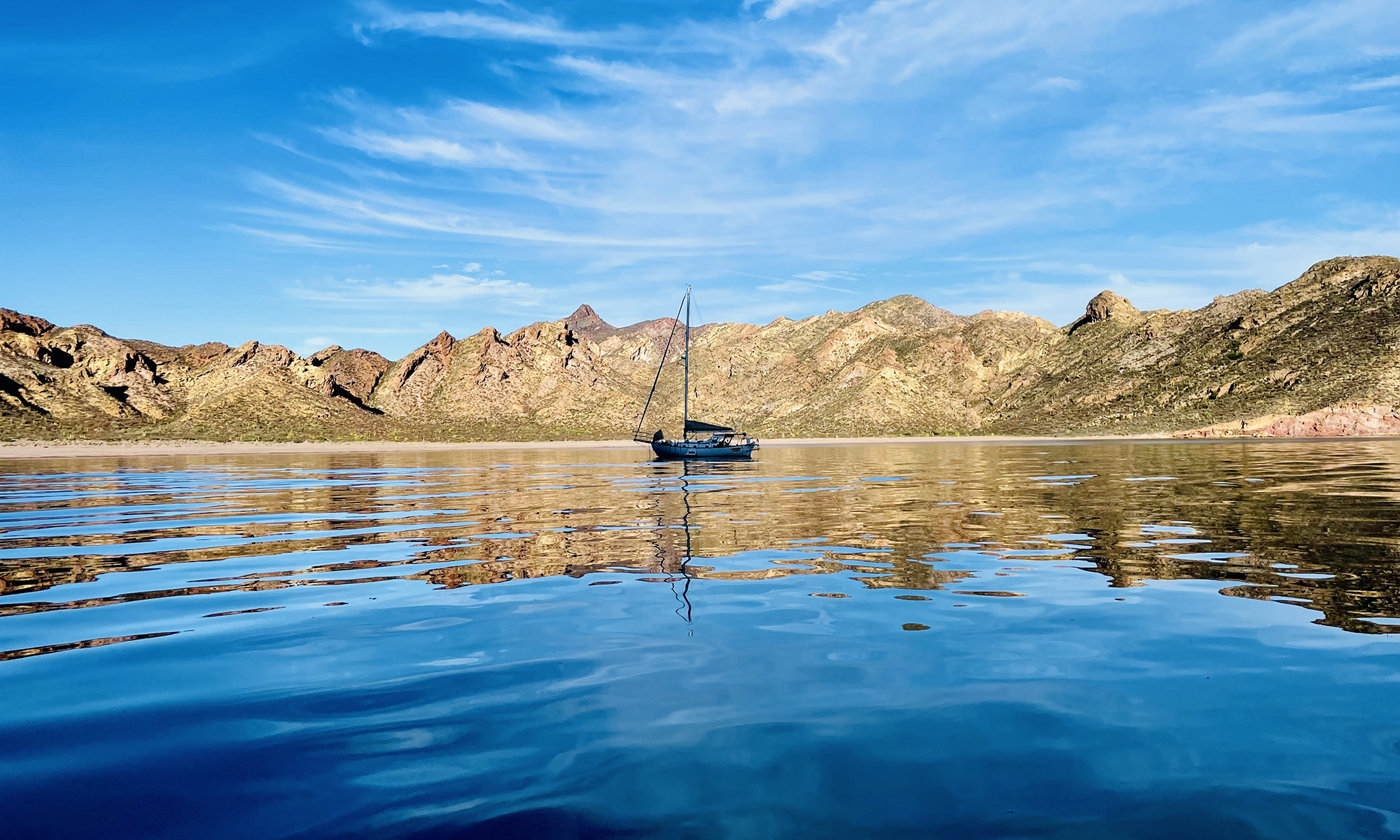
Comments: I woke up this morning and there was zero wind. The water in the harbor was like glass. The lack of motion actually woke me up. My punch list of things I need to do in Tonga is growing short. The weather to Vanuatu is looking sporty, with sustained winds at times in the mid 20s and gusts to the mid 30s. Those conditions could be rough on my foresail, so I want to rig my storm staysail today. I have never had it aloft, so I need to work out the sheets and possible a pendent to get it over the rib. I took advantage of the calm to raise and inspect the mainsail. I also looked into putting in the third reef. It would require putting in a couple of reinforced grommets. I raised the storm staysail. I needed a pendent for the storm staysail which I made out of 1/4” Dyneema with anti chafing tubing at the eyelets. I rigged it with only one sheet as I suspect I will not be doing much tacking when I use it. I had the laundry done, started doing some provisioning, and sent the Advance Notice of Arrival to Vanuatu.

Check-in June 12, 2025; 1:12 UTC

Current Position: 18 39.529’S 173 59.003’W; Local Timezone: UTC+23; SOG: 0 kt COG: N/A; TWS: 11 kt; TWD: 160; Distance to Waypoint (Vava’u): At Anchor; Total Miles Sailed: 5750 nm;
Comments: I started repair of the toe rail beneath the port stanchion that supports the 6 hp outboard. A chunk of wood came out and the underlying wood did not support one of the screws. I replaced the screw with one much longer and patched the wood with epoxy and West Systems 407 low-density filler. I also repaired several other stanchions either by putting in longer wood screws or drilling through and using a bolt. I finished making my new fishing gaff. I sorted through some longer-term provisions and restocked my pantry with non-perishables. I spent the rest of my day researching my route and exploring the formalities. I updated the website with my new itinerary, which involved skipping Fiji, and Going to a different port in Vanuatu. I considered the possibility of skipping Tuesday Island, but that would mean a nearly 300 nm trip to Darwin. I also considered a stop in Indonesia, but there were security and timing issues, so after Darwin I will go to Christmas Island. I looked at the longer-term weather forecast. I am going to try to finish my work on the boat by Saturday, then spend a few days exploring the islands, before return on Wednesday overnight. I will probably check-out Thursday morning.
Sent from my iPhone

Check-in June 11, 2025; 1:44 UTC

Current Position: 18 39.529’S 173 59.003’W; Local Timezone: UTC+23; SOG: 0 kt COG: N/A; TWS: 11 kt; TWD: 160; Distance to Waypoint (Vava’u): At Anchor; Total Miles Sailed: 5750 nm;
Comments: I am going to try to fix the boom today. I started by swinging the boom to the starboard and lashing it so it was not over the solar panels. I then lashed the mainsail to itself (not the boom), released the clew and the tack, and lifted it out of the way (up the track), before lashing it to the mast (to reduce the windage). I unbuckled the bottom of the stack pack and folded the sides up so I could see what I was doing. I secured the topping lift so the far end of the boom was about level and released the pneumatic boom vang. I tied a line about two-thirds down the boom, ran it through a block I had attached to the deck and back to a winch (so I could keep the boom from swinging forward). I ran the spinnaker halyard around and attached it to a loop that was near where the boom vane attaches so I could lift/lower the near end of the boom. At that point I removed the remaining three screws on the side of the boom and used the winch to separate the boom from the gooseneck plate. Once inside I discovered my plan to put a threaded rod through the hole that was stripped was not going to work because there is a tube welded inside for the gooseneck that is in the way. However, I decided to tap the stripped hole to 10 mm. I did not have a 10 mm tap and I didn’t want to spend the $150 to by a set, so I took the 10 mm 316 stainless rod and fashioned a tap, which wouldn’t work for hardened steel but was just fine for aluminum. The thread is not complete because of the rounding of the hole when it was stripped, but I believe there is enough thread to hold. All of the 5/16” screws were replaced with 5/16” bolts with lock washers, except for the one that was stripped, which was replaced with a 10 mm bolt and lock washer. Before I put everything back together, I searched for a 7/16” bolt (I have a 7/26” tap), but could not find one. I have 1/2” bolts and taps, but did not want to remove that much material from the boom. I had to be careful tightening down the bolts because there is not much aluminum in the female thread. In fact, when putting in the second bolt in on the port side, the same side as the stripped thread, I found it too was stripped. It tried putting in a 10 mm bolt, but it did not feel secure, so I put a 10 mm rod through the boom and used nuts to secure it. That certainly is not going to fail. Putting the boom back on the gooseneck was a challenge because of the weight and forces involved and the fact the alignment had to be perfect to pass the pin through it. I ended up using the windlass capstan to drag the boom forward to align the holes. I could tell by the forces on the rope I was using that I could never have done it by hand. The rest of the job was easy, just putting everything back together. What I find during jobs like this is you take one step forward and two steps back. I discovered a zipper on the sail pack needs to be sewn and I saw one screw was missing, one had the head broken off and several others were loose or stripped on the boom vang. There was nothing I could do about the screw that was broken off, by the three 1/4” screws that were stripped were tapped to 5/16” and replaced with bolts and lock washers.

Boom Repaired

I was horrified during my passage from Tahiti to Tonga that the plate that holds the gooseneck onto the boom was missing a screw (it had stripped out) and two if the remaining three screws were very loose. Furthermore, the gooseneck itself was missing a screw, but there was nothing I could do about it while at sea because the screw had a nut on the inside of the boom that had fallen off. The outcome could have been catastrophic had the plate broken free. I tightened the loose screws and monitored the situation for the remainder of the passage.

I have been in Tonga several days now and have managed to find the parts to fix the boom. I started by swinging the boom to the starboard and lashing it so it was not over the solar panels. I then lashed the mainsail to itself (not the boom), released the clew and the tack, and lifted it out of the way (up the track), before lashing it to the mast (to reduce the windage). I unbuckled the bottom of the stack pack and folded the port side up so I could see what I was doing. I secured the topping lift so the far end of the boom was about level and released the pneumatic boom vang. I tied a line about two-thirds down the boom, ran it through a block I had attached to the deck and back to a winch (so I could keep the boom from swinging forward). I ran the spinnaker halyard around and attached it to a loop that was near where the boom vane attaches so I could lift/lower the near end of the boom. At that point I removed the remaining three screws on the side of the boom and used the winch to separate the boom from the gooseneck plate.

Once inside I discovered my plan to put a threaded rod through the hole that was stripped was not going to work because there is a tube welded inside for the gooseneck that is in the way. However, I decided to tap the stripped hole to 10 mm. I did not have a 10 mm tap and I didn’t want to spend the $150 to by a set, so I took the 10 mm 316 stainless rod and fashioned a tap, which wouldn’t work for hardened steel but was just fine for aluminum. The thread is not complete because of the rounding of the hole when it was stripped, but I believe there is enough thread to hold. All of the 5/16” screws were replaced with 5/16” bolts with lock washers, except for the stripped, which was replaced with a 10 mm bolt and lock washer. Before I put everything back together, I searched for a 7/16” bolt (I have a 7/26” tap), but could not find one. I have 1/2” bolts and taps, but did not want to remove that much material from the boom. I had to be careful tightening down the bolts because there is not much aluminum in the female thread. In fact, when putting in the second bolt in on the port side, the same side as the stripped thread, I found it too was stripped. I tried putting in a 10 mm bolt, but it did not feel secure, so I put a 10 mm rod through the boom and used nuts to secure it. That certainly is not going to fail.

Putting the boom back on the gooseneck was a challenge because of the weight and forces involved and the fact the alignment had to be perfect to pass the pin through it. I ended up using the windlass capstan to drag the boom forward to align the holes. I could tell by the forces on the rope I was using that I could never have done it by hand. The rest of the job was easy, just putting everything back together. What I find during jobs like this is you take one step forward and two steps back. I discovered a zipper on the sail pack needs to be sewn and I saw one screw was missing, one had the head broken off and several others were loose or stripped on the boom vang. 

Check-in June 10, 2025; 01:24 UTC

Current Position: 18 39.529’S 173 59.003’W; Local Timezone: UTC+23; SOG: 0 kt COG: N/A; TWS: 11 kt; TWD: 160; Distance to Waypoint (Vava’u): At Anchor; Total Miles Sailed: 5750 nm;
Comments: In addition to surveying the entire boat (every nut and bolt), my priorities for repairs are 1) reinforce the stern pulpit, 2) make a repair to the boom where the fourth bolt is stripped, 3) get my LP tank filled. A Quick Look around this morning and I found another screw missing, this time from the gooseneck bracket itself. This is very serious. This morning, I am going to the Tropicana Cafe, where they are supposed to fill LP bottles on Tuesdays at 9:00. I have partially used two of the three bottles. The first one developed a leak that I need to fix and the other I have used more.The weight of the the first bottle is 19.6 lb and the weight of the second 14.0. The tare weight is 9.9 and the full weight is 23.6 lbs, so I have used 23.6-19.6=4 lbs of fuel in the first and 23.6-14.9=9.6 lbs of the second for a total of 9.6+4=13.6 lb. The capacity is 23.6-9.9=13.7 lbs, so I have only used one-third of my LP fuel in three months. Although there is quite a bit of fuel remaining in the tanks, this is one of the few places that use LP and has the adapters in the South Pacific, so I am going to get them filled. I arrived at Cafe Tropicana right at 9:00. There was already a bunch of bottles waiting to be filled. I was told they’d be ready by noon. I took the opportunity to have breakfast. I asked about a 10mm tap (to repair the boom) and was sent on a 20m walk to a hardware store who had a tap and die set for $150. I decided to hold out to see if I could find an alternative solution. The store did have a good handle for the gaff so was planning to make, so I got it, even though it was $25. I walked to the marine chandlery and I was shocked to see 316 SS threaded rod immediately as you walk through the door. That was exactly what I need to fix the boom. I also bought the nuts and washers. As I was preparing to pay, I asked if they happen to sell gaffs. The lady apologized and said no, just the heads, and then she produced a sharpened and bent piece of stainless rod that was exactly what I had been planning to fabricate from some rod I had onboard. Score! I took my haul to the boat and returned at noon to the Cafe Tropicana to fetch my LP tanks, where I was told they couldn’t fill them. Some research on the internet taught me that Mexico gets almost all of its LP gas from the US, and the US refines its LP gas so that it is almost pure propane. The LP gas in Tonga is a mixture of propane and butane. Because the former is more volatile that the latter, Tongan LP gas cannot be condensed into a tank that has US LP gas in it. Rather than empty one of the tanks, I decided to continue using it expecting it to last until Thursday Island. On a sour note, I have come to realize that that the plate at the end of the boom to which the gooseneck is attached is bolted from the inside, which means the boom will have to be taken apart to do a repair. This is going to be a big job. I am working on a hydraulic system to support the boom so I don’t need to remove the mainsail. I will have to undertake this project early in the morning, because high winds typically develop in the afternoon. This may be for the best, because I can inspect inside the boom to see if there has been any damage after sailing with only two of the six screws (one lose and one missing on the front and one missing and one loose of the four on the side) firmly attached to the gooseneck plate.

LP Tanks from Mexico Should Not Last As Long As LP Tanks From Tonga

I took two LP gas bottles to be refilled today in Tonga and was told, after they tried, that they could not fill them. The tanks were previously filled in Mexico. Some research on the internet taught me that Mexico gets almost all of its LP gas from the US, and the US refines its LP gas so that it is almost pure propane. The LP gas in Tonga is a mixture of propane and butane. Because the former is more volatile than the latter, Tongan LP gas cannot be condensed into a tank that has US LP gas in it. It is also noteworthy that propane burns hotter than butane on a per molecule basis. So the question is, can you expect a tank of liquid propane to last longer than a tank of butane (or propane/butane mixture)? The heat of combustion is related to the H/C ratio for hydrocarbons and propane has a higher H/C ratio than butane. The formulas for combustion are:

C3H8 + 8 O2 → 4 H2O + 3 CO2

2 C4H10 + 13 O2 → 10 H2O + 8 CO2

The additional heat for propane vs. butane per molecule is given roughly by:

(8/3)/(10/4)‎ = 1.0667

The heat of combustion (at standard temperature and pressure) of propane is 2220.1 kJ/mol and for butane is 2877.5 kJ/mol. The density of liquid propane at room temperature (25°C) is approximately 0.493 grams per cubic centimeter.  For butane it is 0.599 g/cm3. So if we assume are tank is 1 cm3 (does not matter what size it is for the calculation), propane produces:

0.493 g/cm3 X (1/44.10 g/mol) X 2229.1 kJ/mol = 24.92 kJ/cm3

Butane produces:

0.599 g/cm3 X 58.12 g/mol X 2877.5 kJ/mol = 29.66 kJ/cm3

So, for a given volume of liquid gas at room temperature, butane produces more energy than propane (29.66/24.92=1.19, about 20%). While propane has a higher calorific value per unit of mass, butane’s higher specific gravity (density) means it packs more mass into the same volume, resulting in a higher overall energy output per volume.

There is a potential issue regarding mixtures of gases (if we are not dealing with pure propane or butane), namely if the molecules interact in some way, but hydrocarbons are generally considered to be “ideal gases” (and ideal liquids).

Bottom line … same-sized LP tanks from Mexico should not last as long as LP tanks from Tonga.

You might ask why there are different formulas for LP gas. Propane is more volatile than butane, so it is more suitable for the cooler climates. Tonga does not have to worry about vaporizing butane.

Check-in June 9, 2025; 1:16 UTC

Current Position: 18 39.529’S 173 59.003’W; Local Timezone: UTC+23; SOG: 0 kt COG: N/A; TWS: 11 kt; TWD: 160; Distance to Waypoint (Vava’u): At Anchor; Total Miles Sailed: 5750 nm;
Comments: I was really reluctant to move the boat to the customs dock. I have a good mooring and it is always a challenge to grab one by yourself without dinging one of the mega yachts you’re surrounded with. Hopefully it will still be here when I return. Ideally, I am suppose to visit the dock at high tide because it is a commercial dock, not really built for small boats, and the tide here can be six feet. Unfortunately, high tide is at 5:00 AM and 5:00 PM, outside the working hours of the officials. Also unfortunate is several other boats came in over the weekend, a cargo ship came in overnight and is occupying most of the dock, and customs was closed yesterday so all the boats that came in over the weekend are queued up for check-in. I see one has been circling by the dock for an hour. To make matters worse, the wind is picking up, making it impossible to stay still without being moored. It looked like there was room at the end of the dock, but then I remembered that there is a wreck there. The ship left about 11:00, making room for myself and one other boat (Danza, the boat that passed me in the last night of the passage) at the commercial dock, which is about three times taller than the fisherman’s dock and is covered in barnacles. I dropped a second float and left my bridle to “mark my mooring”. Danza, a 60’ ketch, went first and I rafted with her, making my job easier as her whole crew helped me tie up. I was visited first by customs, who gave me a stack of papers to fill out. Quarantine visited next, asked about my provisions and if I had any animals aboard. Health visit next and the official certified me healthy. I was then sent to an ATM to withdraw Tongan currency, 22 TON for Quarantine and 109 TON for Health (about $60 total USD). Customs then returned, examined my paperwork and asked a few questions. I was surprised that he took the Zarpe from Tahiti. I took a photo before he did. None of the officials went below deck, and all three were friendly and very professional. By 14:30, I was back on the mooring ball. The yellow Q flag came down. Aegir-Ran will be at home on the mooring ball for a week while I make repairs and provision. I will then explore some other anchorages before I return to check out. I am not going to check out in a Monday though. I am going to my to celebrate by putting the dinghy in the water and go into town for a meal.

Check-in June 8, 2025; 2:00 UTC

Current Position: 18 39.529’S 173 59.003’W; Local Timezone: UTC+23; SOG: 0 kt COG: N/A; TWS: 11 kt; TWD: 160; Distance to Waypoint (Vava’u): At Anchor; Total Miles Sailed: 5750 nm;
Comments: By 16:30, the wind had backed to the W enough that it was no longer possible to close haul due W and I started to sail south of the latitude for the N end of Vava’u. Since I do not know how long it will take for the wind to back to the S, I will tack in about 3h and regain some of the latitude. The course plotted by PW says the wind will be about 200 at midnight. So, if I head S for 3h and then tack and head N for 3h, I should be at the correct latitude and can reach W until aI arrive at the waypoint. Since I should only be 25 nm from the waypoint then (midnight), I will likely shorten sail to time my arrival after dawn. At 17:00, an hour before sunset, the TWD was 300 at 15 kt. When the direction reaches 270 or so, I will be heading almost due S. At that point I will tack. Depending on the wind conditions and how far I am from the waypoint, that may be a good opportunity to shorten sail. I couldn’t let the thing with the charger go. I ended up working on it for an hour. First, I wired the old charger to power and confirmed the settings. Then I transferred the settings to the replacement charger. It stated it was charging but the current wasn’t flowing through the shunt. I double-checked the correct negative wire was connected and I measured voltage coming out of the charger to the Li battery bank … only that is not what I was measuring. I was measuring the back voltage from the Li bank to the charger. Once again I was done in by a bad connection at a Victron device. Once properly connected, it worked fine and I put a charge on the battery bank. In the meantime, it is 22:00 and I am still sailing. I have 49 nm to go to the N end of the island., doing 5 kt on a 248 course (waypoint is at 267). Wind is 15 kt from 322 and I am sailing a close haul on this approximate heading for 2h more, when I will tack. I am guessing I’ll reach the latitude of the waypoint (18 30S) about 1:00 and will be about 32 nm away. At that point I should be able to sail due W and with an average speed of 4.5 kt I should be at the waypoint by 8:00. I will probably loose the wind in the lee side of the island and will have to motor the 15 nm or so to the entrance if the convoluted channel to the harbor. Navigating the channel will probably take a couple of hours. At 21:00 a 20 kt wind surprisingly hit from 340, causing the boat to round up and actually point NW towards the waypoint. This was followed by rain, obviously the edge of a squall. Since I was headed in a desirable direction and I knew it would be temporary, I made no adjustments to the sails and just went with the flow. At 21:45, on the backend of the storm, I experienced the vacuum and single-digit wind speeds. At 22:30 I was awaken 15m before an alarm because something didn’t feel right. The wind had shifted to 255 and I was being driven nearly due S. There was driving rain, obviously a storm, but I had to tack. Going out onto the deck to remove a preventer in the rain with the boat heeled over far enough for the sea to be rushing over the toe rail was not pleasant, except I did get a nice freshwater shower. Tacking was uneventful and I was soon sailing 288 relative to the waypoint at 273 doing 4.5 kt in an extreme close haul in 17 kt wind. Basically, I was exactly on the course recommended by PW and a hour ahead of schedule about 39 nm from the waypoint. Is the wind continued to rotate southward, the boat would pick up speed and rotate towards the waypoint. I felt good about the progress, but decided to stay awake should the effects of the storm be temporary and a correction be necessary. Indeed, I felt the boat slow and by 23:05 it was headed 325 at 2 kt in 8 kt of wind. I was in the vacuum left by the storm. I simply had to wait for it to pass to discover what the new reality was with respect to wind speed and direction. I was headed in the generally correct direction as I needed to recover latitude. By 23:25, the boat started moving again towards the waypoint 3.5 kt in 10 kt of wind from 200. The wind and the boat were doing what they were supposed to according to the forecast. By 00:45 the wind had stabilized enough that I could take 30m naps. I woke up at 2:15 while dreaming of a leopard attacking me. The boat was surfing over 7 kt in 15 kt of wind. It was pouring down rain. The wind was coming from due S and the rain was cold. I have not had to wear a jacket when working in the cockpit, but I had to return to the cabin and put one on. LlI put the boat back on course going 6 kt with 30 nm to go. It is 4:00, sunrise is at 7:03, and I am 19 nm from the waypoint. Like I did for Hiva Oa, I expect to arrive around sunrise. Since I have plenty of time, my plan is to sail around to the leeward side of the island, but if I get bewinded, I will motor. Once I am outside the channel, about mid morning, I will heave to and take care of some pre-arrival details, which includes sorting out the chain locker, inflating the fenders, sorting out the dock lines, and calling the Vava’u Port Authority on VHF 16 to announce my arrival. It is nearly 5:00. The winds have been light, variable, and unstable as I approach the island. I now have a new waypoint, closer to shore and 14 nm away. The wind vane has struggled to keep course, particularly when the wind is single digits, so I have switched to the (backup) TillerPilot, which is doing well. I will need it when I am motoring around the island anyway. I expect to be at the waypoint around 8:00. I see Danza, the boat that passed me the night before last is at the channel waiting for light. They must not have made it in time yesterday. At 6:00, 10 nm from the waypoint, I got hit by 22 kt winds that overwhelmed the TillerPilot and caused an accidental jibe. I corrected the course and switch to the wind vane. With some drizzle, it feels like a nearby squall. 10m later and it has begun to rain. Visibility may become an issue. The boat is doing 7 kt. It seems we’re going to finish this one with a bang. It is 6:35, a half hour before sunrise and light enough I can see the heavy cloud cover extending to the horizons except for a sliver to the N. 6 nm remain to the northern waypoint. I have had sustained 22 kt winds for the last 35m, driving the boat to near hull speed, 7.4 kt. I am letting the winds drive me a bit N as the boat is showing its two working sails unreefed and is heeled over. The waypoint should be the beginning of the lee side of the island, where I will drop the sails when/if the wind subsides. It is 6:48 and I have spotted Vava’u 5 nm away and surrounded in clouds. It is 7:30, I just passed the waypoint, and I am within half a mile of the northern tip of the island the boat is going hull speed (7.4) in 19 kt of wind. I’ve had to hand steer the last hour. The island is covered in fog and rain. I’ve used Radar to help sort out fog from land masses. A rainbow developed over the island during sunrise. As I rounded the northern tip of the island, still on a course W, the seas calmed, the wind dropped to 14, and the boat slowed to 6. There was a sound I did not recognize, that of the servo rudder slicing through the water. Well, it’s not done yet. At 8:20, it is blowing 25 kt and the boat is surfing at 7.6 kt. The leeward side of the island offered surprisingly little protection. There are some fairly large cliffs, but no mountains or tall hills. The entrance to the channel looks fully exposed to the wind, so I ducked into an indentation on the NW corner of the island to point into the wind and drop the sails. I floated there for a couple of hours taking care of issues before arriving (pumping up fenders, removing water from cockpit lockers, sorting out chain locker, etc.). I moved to the entrance of the channel about noon and tried to contact the Vava’u Customs authorities on the VHF. I then found an e-mail that I had apparently missed that said I should just find a mooring and move to the customs dock on Monday. I contacted Beluga Diving on VHF 9 and got instructions for a mooring ball. Fortunately, one was available and I snagged it about 14:00. The convoluted course to the anchorage was very interesting. I am looking forward to a good night’s sleep.

Check-in June (6) 7, 2025; 2:00 UTC

Current Position: 18 30.106’S 172 50.538’W; Local Timezone: UTC+23; SOG: 6.4 kt COG: 255; TWS: 15 kt; TWD: 340; Distance to Waypoint (Tonga, 257): 62; Total Miles Sailed: 5564 nm;
Comments: Note, I will have crossed the dateline by the time the check-in is submitted. All of the local times reported herein are UTC+23. As I began writing this, it is Thursday 16:30. Now it is Friday 15:30. Sunset will be about 17:50, 2h from now. I am doing 6.5 kt in 20 kt of wind coming from 61. Sometime tomorrow, hopefully later in the day, the wind will drop to single digits. Overnight, the wind is expected to back from the E to due N. It will also reduce in speed from 20 to 12-15. However, I will be sailing on a beam reach instead of a broad reach (nearly a run), so if necessary I can use the staysail to maintain good speed. Ideally, I can knock the current 175 nm to the N side of Vava’u down to 50 nm or so, which I will have to make Saturday night to put me in a position to make my way around to the W side of the island and navigate the complicated passage to the anchorage at Neiafu well before dark on Sunday. It is an hour before sunset. During the last hour the it has gotten progressively darker with a hodgepodge of different types of clouds. I prepared some of the swordfish I caught today. It is going to be in sale the next five days, ensuring I get my quota of mercury. Before dusk, I spotted the 59’ powerboat Danza about 7.5 nm off my starboard quarter doing about 7,5 kt, about 2 kt faster than me. They passed 0.75 nm S of me about 20:30. I downloaded a new GRIB and it does not look good. The winds I am riding now will be gone by morning, not tomorrow night. They will be replaced with a soup of different wind patterns that will require a lot of hands-on to navigate. It is predicted that I won’t reach the northern end of Vava’u until Sunday afternoon, too late to access the anchorage. To make things worse, lightning is expected Sunday morning. Around 00:30, the wind shifted to 45 and I had to trim the sails and rebalance the wind vane to maintain course. The wind vane does not seem to do as well on a starboard tack as a port, which makes sense when I think about how it was damaged. It may need a few more blows from the mallet. It is 4:00. The weather model does not appear to be correct. By now, the wind is supposed to be from the N, but I am getting 14 kt wind from 40, making 4.5 kt, and am 5h ahead of schedule. I trimmed the main, adjusted the wind vane, and checked for an update on the weather. The latest GRIB now says the wind will turn due N over the next 6h and recommends I change course northward at dawn. I am going to try to make progress to the waypoint as long as I can. Basically, I think what is happening with the weather between here and Vava’u over the next 24h is too complicate to model. Even if the current map is correct, I should be able to make progress toward the waypoint for the next 12h. By then, the map will have changed again, as it has every time I have downloaded it over the past 24h. Sunrise should be about 6:50. I woke at 7:00 and it was light. It had just started raining hard. I was at the point where I was supposed to change the course northward. The wind was supposed to be 13 and blowing from 19 and it was 30 and blowing 10, but I figured it could be due to the rain storm. I was right and by the time so had shaken the first reef out and trimmed the sails, I was doing 5.2 kt in 15 kt of wind blowing from 60. .The forecast from a few hours ago was wrong again, but I certainly was not complaining. The course was 266 and the waypoint was at 257. I had managed to end up at the latitude of the waypoint, which was a 100 nm away. I would try to remain at 18 30S and if and when the wind backs to the N, I will be in a position to use the staysail in a beam reach. Had I followed the recommended route, I would have been 45 nm N. Satisfied, but fooling uself that every could so south any moment, I decided to make myself a cup of tea. But, before it was brewed, I was surprised by a strong rain storm. I had been watch upwind for storms, but this came from the bow and as it struck the wind went practically zero. I took advantage be heaving to and retrieving a line I had been training behind the boat for two weeks. The line is attached to the bottom of the servo rudder and is used to raise it when not in use. Retrieving it was on my list of things to do today because I could not run the risk of fouling the prop with it in the water. While retrieving the line, I noticed that the stanchion on port side was missing two of its three screws and the third had backed out and was about to fall into the sea. The stanchion was moving back and forth with the motion of the surge. I quickly took the weight off the stanchion by connecting the hoist to the outboard and tightened the screw. I will need to find replacement screws. I went to the starboard side and sure enough those screws were loose as well. I had been thinking about putting a bar across the stern pulpit for further support. If I can find the stock and the hardware in Darwin, I will do that. In the wake of the strong storm that had passed, not surprisingly, the wind dropped to single digits, causing the boat speed to fall to 2.5 kt. The direction changed to 60, but I knew this was all going to be short-lived, so I didn’t even try to adjust the course or trim the sails and instead went with the flow so I could finally enjoy my tea. While drinking my tea in the cockpit, I downloaded a new GRIB. Of course the weather had changed. It now recommended I do what I had been doing the past 24h, make my way towards the waypoint. My motive for retrieving the line was the expectation the wind would get confused at some point and I would need to motor out of dead air. Until I found the energy to rummage trough the extra hardware locker, a laborious task that involves removing most of the storage containers in the upper pilot’s berth on the port side, I cannibalized two screws from less important stanchions. As I enjoyed my tea, the sun came out from the storm that had just passed and I noted that it was surprisingly clear ahead. Surprisingly, because thunderstorms are predicted later. I started to parse my punch list for today. If all goes as planned, I will arrive at port tomorrow and I need to do things like inflate the fenders, which I have not used since leaving San Carlos. Since the seas were unusually calm and the boat was moving slowly, I decided to take my tea on the foredeck, wearing my harness of course. It was there that I averted near disaster. Two of the four screws that held the boom on were missing and a third was loose both screws on the port side were missing and the boom was flexing in the fitting that connects to the gooseneck. I quickly went below and found replacement screws. They were unusual, large, but recognizing the importance of having spares, I had two in my emergency hardware box. With the help of the engine, I put the boat in a position with respect to the wind that moved the boom to line up the screw holes. Because if the forces involved, there was no way U was going to be able to manhandle it into position. I discovered that the top screw had stripped out. That is probably what caused the problem. I would need to tap the hole and put in a larger bolt, but I did not think I had a large enough. I would check later. Fortunately, the forces should come mostly from the starboard side until I reach Vava’u. I of course examined the rigging in Tahiti and did not spot the missing screws. So I suspect they came out during the passage. It is possible they were loose before that and I just didn’t notice. I am going to have to take the time to check the security of every piece of hardware on the deck and in the rigging after every passage. By that, I mean get a driver/wrench in every piece of hardware and check that it is tight. It is 9:30 and the sun has come out. I have been trying to have my tea for almost two hours. It is still hot in the thermal mug. I will need to lash secure the boom to minimize its movement for the remainder of the trip. I also noticed the sheet for the jib is getting warm where it goes through the block. I need to reverse the line, but that involves lowering the jib because the line is attached too high up to reach. The cabin looks like a bomb went off. Looking for the hardware I need, I threw stuff in a pile, and that pile was quickly spread all over the floor by the motion of the boat. I am running down my priorities. I can see rain clouds windward. I am going to produce very little solar today. I decide to get the cabin put back together again, make some breakfast, pull the DC-DC charger from beneath the V-berth, and replace the one in the engine room. It will be a challenge, not only because of the motion of the boat, but because most of the stuff on top if the V-berth will have to be moved to get to the compartment with the controller. I’m finishing my tea in the cockpit before getting to work when I see a show float by. It is too far away to reach. I see amazing little flotsam out here. With all of the commotion, I am already an hour behind the schedule that was made two hours ago. It took me about 30m to get DC-DC #3 out from underneath the V-birth. It was very hot and humid, and I was dripping sweat on the Li batteries and electronics. I was worried I was going to cause a short. As I was taking the unit out, I was reminded it is the “non isolated” version whereas the one I am replacing is the isolated version. However, since the Li and AGM banks share a common ground, that shouldn’t be a problem. In fact, it is easier to install the non-isolated version because it only has a three large cables at the base instead of four. By the time I got back to the cockpit to cool off it was nearly 11:00, and clouds had replaced sunshine. I did not see any breaks in the thick, dark clouds, so I don’t expect much solar energy. The wind was in the single digits at 22 and the boat was crawling along at 2.8 kt. In a positive note, with the boat hardly moving and the seas calm, it was going to be easier to work in the engine room. While sitting in the cockpit thinking about the process, the wind suddenly shifted to due N and started blowing double digits. I trimmed the sails and set the single vane and was suddenly doing 5.5 kt. I started working in the engine room at 11:15. It was warm from running the engine for a minute earlier. I should disconnect the batteries before working on the charger, but that would cause all sorts of problems with the instrumentation, so I worked with hot wires, successively removing the negative, insulating the wire with electrical tape. Since the units were the same dimensions, it was pretty much plug-and-play, except ai replaced the two grounds with one. I used the ground to that main buss rather than the one from the engine block, and double checked the AGM side was hot. The input side of DC-DC #1 was black. It had clearly been shorted out and that was likely the cause of its failure. DC-DC #3 has been programmed to charge a Li bank from another Li bank. I had to reprogram it to charge from an AGM bank. After doing that, I the substitute DC-DC #3 was tested and I thought it works, but the excess current is not being detected at the shunt. There were two grounds going to the isolated charger and I arbitrarily picked one to use for the non-isolated charger. I thought both grounds when to the buss, but now I am thinking one went to the shunt and the other to the buss, and I picked the one that went to the buss. It does not matter in that the voltage of the Li bank tells me the state of charge, but it is convenient to have an amperage inventory. I have to rewire the shut anyway (because the small inverter I use for the computers is wired to the wrong side of the shunt. On further testing, it is clear current is not flowing between the battery banks. I will deal with this in Tonga. I will connect DC-DC #1 to a battery source and check its setting to make sure the ones I am using are correct. I vaguely remember it took some time to set this up. I knew something was going on while working in the engine room. When I returned to the cockpit I discovered the boat was doing 7 kt in 27 kt of wind. I adjusted the course to the waypoint and was still making over 6.5 kt in 16 kt wind from the N. Just when I thought there is zero chance I will make it in time tomorrow to anchor, the wind gives me some hope. I’ve only made 16 nm in 5h, an average of 3 kt. 85 nm to go to the north side of the island. It is 13:15 and I have 78 nm to go, During the period that distance is covered (between now and 8:00 Sunday morning), the wind is supposed to back (shift counterclockwise) 180 from N, where it is blowing at 15 kt now) to S. There is a dead zone I cannot sail between, about 220-300 degrees from my current waypoint direction of 257 (due W). In the 18h or so, I assume about 9 will be N of me and 9 will be S. I am sailing a beam reach now as the wind blow from the N. Over perhaps the next 6h, that should change to a close reach and eventually a close haul, at which time I will need to head S to still make progress. Eventually I will tack and head N again to make up the difference. It should be something 14:00 to 20:00, head W. 20:00 to 23:00 head S. Tack and head N 23:00 to 2:00. Finally, head W 2:00 to 8:00 to make the waypoint. The period between 20:00 and 2:00 in particular will require quite a bit of hands on sailing. So, I don’t expect to get much sleep tonight. At 14:00, I am heeled over 15 degrees doing almost 7 kt. I am worried about the stern pulpit. I have taken as much weight as I can that is supporting the 6hp outboard using the lift. I just put a cargo strap between the two stanchions with the outboards to lend more support. Sunset should be about 18:05, 2.5h from now. I have done 181-62‎ = 119 nm on in the last 24h, which is very good considering I was largely becalmed most of the morning. I am sailing with the full Yankee and no reefs in the main, which I what I plan to do overnight as gusts over 18 are not expected.
Check-in June 5, 2025; 2:00 UTC

Current Position: 18 48.256’S 170 47.086’W; Local Timezone: UTC-10; SOG: 5.4 kt COG: 260; TWS: 18 kt; TWD: 67; Distance to Waypoint (Tonga, 262): 181; Total Miles Sailed: 5538 nm;
Comments: It is 16:00 and I am at 169W. The 20 kt wind that has allowed me to sail essential E using just my foresail is going to disappear by dawn and be replaced with 12-15 kt wind with gusts of 20. At the point I will have to raise the main and jibe to a broad reach towards Tonga. My plan is to continue E until I reach 170W, then jibe. It should take me 10-12h to do that, making it 2-4:00 in the morning. This should place me about 240 nm from Tonga in the morning and after sailing 4-5 kt/h during the day, about 180 nm from north side of the Tonga island Vava’u by the end of the day tomorrow, Thursday (Friday Tonga time). The wind will go to single digits by tomorrow night, so there is no chance I will make safe harbor by Friday (Saturday Tonga time). My plan is to cover that 180 nm over the Tonga weekend and position myself to come into the harbor first thing Monday morning (Sunday my current time). During the next two days, the wind will shift from the E to the NNE, allowing me to curve around on a bean reach for Vava’u, using all three sails in the light wind if necessary. The wind is going to shift to the SE and become strong on Saturday afternoon through Sunday morning (Sunday-Monday Tonga time) making it more difficult to heave to. So, if the opportunity presents itself, I will try to make safe harbor Saturday before dark (Sunday Tonga time) and stay on the boat until the quarantine procedure is complete. It is 17:30 and I just downloaded PW data. For the first time the AIS data includes the harbor at Vava’u. There are at least 16 vessels at anchor there and a dozen more are anchor in the island group. White Malkin is there and Little Wren SoloSail is on the N side of the island, presumably heaving to until daylight. Sunset should be at 18:45 (UTC-10, about one hour from now) and I will be at the waypoint PW recommends for jibing in about 40m. The advantage of jibing now is I can raise the mainsail in the light and trim the sails before it gets dark. The advantage of waiting is sailing with the foresail along is generally trouble-free, although I continue to loose latitude (and will loose more as the wind shifts to the E). I believe I will lift the main before dark just because I’ll probably have at least 45m of light to sort things out if there is a problem. I will start by furling in half of the Yankee and I will start with two reefs in the main because I still expect 25 kt gusts tonight and sustained winds of 20. Further, I will be exposing more of the sails in the broad reach. I needed every minute of light to hoist the main and tune the wind vane. I had trouble in the 25 kt hoisting the main because the top baton kept getting hung up on the lazy jack. I eventually dropped the lazy jack and sail pack to get the mai up, then put everything back together again. I finished just as it got dark and a squall hit. The boat is doing almost 6 kt in 25 kt wind with about half the Yankee and two reefs in the main. The wind direction is 85 and I am in an extreme board reach, almost a run. I am about 45 nm from Niue. I believe I will average about 5.5 kt, so should be there in about 8h, which would be 3:00. There is perhaps a 50:50 chance I am going to have to jibe before I get there, and I don’t want to take any chances in the dark. Note that even after all the gymnastics to get the main up, I am exactly on the course recommended by PW, which predicts I will reach Niue at 9:00, much later than I likely will. I will set alarms and stay awake the couple of hours that will be necessary to clear Niue. Just as I was typing this, a squall hit with 30 kt winds, causing the boat to round up a bit towards the island. I am going to have to be cautious. I note this starboard tack is much more comfortable than the port tack was, I think because of the direction of the swell. It was hitting me broadside before and it seems to be following seas now. The TWD is shifting as I approach Niue. At 00:15 it is 76 and I am 16 nm away. This may allow me to pass the island without jibing, but it will be very close. The problem is, while the wind vane is doing a very good job, as mentioned before, I am getting periodic gusts of 25-30 kt that are causing the boat to round up. I am now staying awake to hand steer through those gusts. I am down below, but the sounds of the wind/water and the heeling signal when I need to take control. Niue is about 8 nm wide and normally when you approach the windward side of an island, particularly one with some elevation, the surface wind direction will change as the wind is parted around the island. I am looking for that. It is 1:00 in the UTC-10 timezone and my phone just switched to midnight (UTC-11). Interestingly, the time on PW has also switched to UTC-11. It is 1:30 and it has become clear that it will not be necessary to jibe. It would appear that my closest approach will be about 5 nm and it looks like I will pass the island 4h ahead of the schedule that was downloaded at 17:00 yesterday. The town of Alofi is on the leeward (opposite) side of the island, so it is not surprising that I do not see any lights. There are roads on this side of the island, but I do not believe there are any concentrations of population. At 3:00, I passed the closest point to Niue, about 5 nm. Once past, I downloaded a new GRIB, extended AIS data, and a weather routing plan. I have managed to shave an entire day off of the passage. The plan shows an arrival to the N side of the island about 22:00 on Saturday Tonga time. I will plan on navigating the complicated channel to anchorage on Sunday morning. It is 4:30 (UTC-10), I am clear of Niue, wind is blowing at 20 kt, I am traveling at 5 kt, and there is no AIS traffic, so I am going to sleep. I have 60h to make the 230 nm to the N side of Vava’u, the 15 nm or so around to the channel on the E side, and navigate the convoluted channel to the anchorage. There is no rush, but when I wake up I am going to deploy more sail to take advantage of the 12-15 kt wind I will have the next 48h. I woke at 7:30 UTC-10. This will be the last check-in at UTC-10. Beginning 2:00 UTC, after I do this check-in, I will switch to UTC+23 (as if I had crossed the dateline). In other words, it is Thursday 7:30 UTC-10, but Friday 6:30 UTC+23. I am about 15 nm E and downwind of Niue. I woke up and the boat was going 3.5 kt in 12 kt of wind. To get out of the shadow, I unfurled most of the Yankee and adjust the course to a more acute wind angle (145). The TWD was 70. This put me on a course of 285 and gave me a boat speed of 4.9 kt. Sunrise was at 7:48. The wind is supposed to back from 80 to 68 by mid morning, at which time I will adjust the course closer to the waypoint (which is currently 266). The sky this morning is largely without clouds, except on the horizons, and the waves are substantially less high, perhaps affected by Niue. At 8:30 I shook out the second reef. I was making about 5 kt in 16 kt wind. I rigged a preventer and put out a fishing line.in celebration of passing and Niue and reaching waters that were not as angry, I cooked a large breakfast of eggs, potatoes, onions and prosciutto. At 9:30 I seemed to be out of the island’s shadow and was making 5.2 kt on a course of 285. As predicted, the wind start to back to 68 about 10:30. The nice thing (sometimes) about the wind vane is it steers relative to the wind. I did not need to make any adjustments. The boat automatically steered closer to the waypoint. By 11:00, I was out of the “wave shadow” of Niue and the big swell was back. I was really glad I had fixed the meal and cleaned up before the rocking returned. The wind became variable in speed and direction, making it difficult to trim sails and run a steady course. The boat bounced between a course of about 275 at 5 kt and 300 at 6 kt. I just went with the flow and figured it would sort itself out soon enough. About noon, I got a strike on the fishing line. I was a 7’ billfish. Having lost my gaff and not having any interest in bringing a billfish aboard by the gills, I ran a noose of rope down the fishing line and it naturally stopped at the tail. After cinching the loop, I dragged the fish aboard tail-first. The course recommended by PW has been very accurate today. Including changed in wind direction and strength. Since Niue, I have basically been curving around to the E as the wind direction changes. However, the forecast has changed every time I new GRIF has been issued with respect to were the dead air is going to be and when, so basically I cannot plan for that. Instead I am keeping the GRIFs up-to-date and downloading frequent weather plans. The distance sailed on to Tonga in the last 24 h was 290-181=139 nm (a remarkably good day).