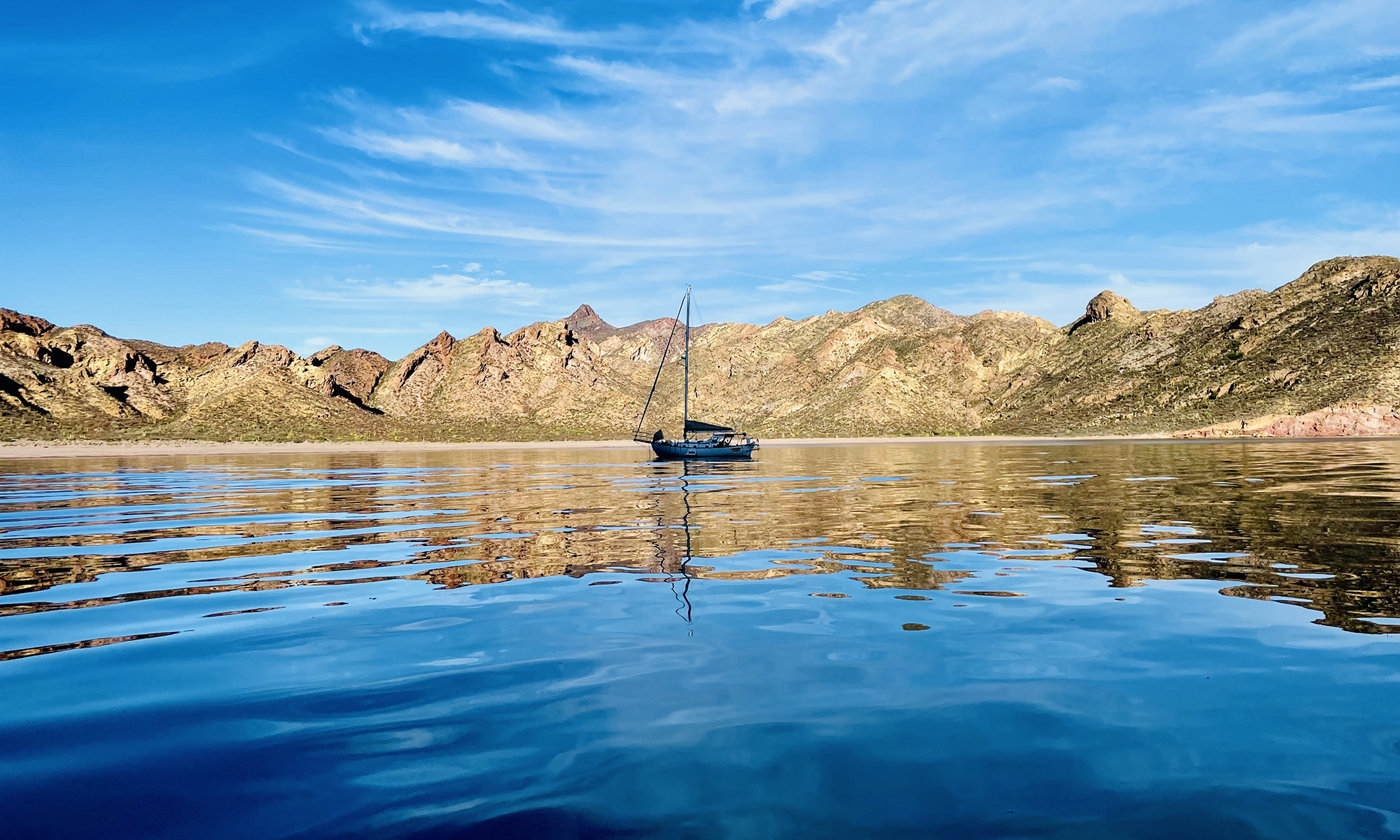
Current Position: 11 44.550’S 144 03.375’E; Local Timezone: UTC+20 SOG: 0 kt COG: N/A; TWS: 18 kt; TWD: 141; Distance to Waypoint: at anchor; Total Miles Sailed: 8683 nm; Engine Hours: 183 Estimate Fuel: 53+13+50
Comments: Sailing started off well following my last report. By 17:00 I had a 1 kt current directly to my stern and was making over 7 kt SOG in 19 kt of wind from 143 directly towards R1. I noted that sunset was at 18:05. It remained relatively light until 17:30. The sunset at Raine Island tomorrow is scheduled for 18:16. It is 20:00 and there are 105 nm to R1. I have averaged 6.6 kt the past 5h. It is 3:00 and I was waken up by a 23 kt gusts from 150 that was causing the boat to surf. Only 62 nm remaining to R1, so the boat has done 138-62=76 nm in the last 12h, 76/12=6.3 kt avg. I still have 0.5 kt current to my stern, but I will loose that soon as the current is expected to come from due S until I reach R1. I woke up at 5:50, about an hour before dawn, to a small squall with light rain. The current is now nearly perpendicular to the port side. The boat was averaging 6.3 kt. When it became light I discovered I was surrounded by a half dozen squalls. All appeared to be low-energy. Even before my tea this morning, I went forward to sort out the chain. It was not as badly tangled as it is sometimes after a passage. Every 30m-1h, the weather was changing from almost cloudless to squally and back again. It is 9:30 and the boat has been averaging 5.6 kt since dawn toward R1, which is now due W (260). The head is about 252, but a 1 kt current from the S is keeping the course 260. The ETA for arriving at R1 is 15:00, when I usually submit this report, but I will wait until I am at anchor at R2 (The Great Detached Reef). Since I have time, I will motor into the reef and anchor in the shallower water. It began raining about noon when a very big squall passed my stern. It largely missed me but the boat is affected by changing winds. It is 13:00 and I am 8 nm from R1 and perhaps 14 nm from dropping my sails there are more big squalls on the horizon. Hopefully I can time my arrival (or at least dropping the sails) when it is not storming. I won’t have time to fix dinner until after I anchor, so I am eating a bowl of noodles to tie me over. I just picked my first AIS shore station … 86 nm away. A squall hit me about 13:30 with 23 kt winds, about 5 nm from R1. The boat speed increased to 7 kt. The wind backed to 105. I hand steered to keep the boat on course. Unfortunately, the rainfall masked any landmarks, including the tower on Raine Island. R1 sits on a line that comes very close to the E coasts of Raine Island and the GDR. That line does not run N/S because the GDR is further E. 2.5 nm From the lineThe distance between them is roughly 5 nm. Finally, the squall let up and at 2:05 I spotted the tower on Raine Island. Up to now the island was covered in rain. As I crossed the line at 2:30, the GDR was about the same distance off my port, but I could not see breaking waves, perhaps because I was effectively on he leeward side of the reef. Except for the tower, I could not make out either feature due to the poor visibility. I might just as well come in at night. I did notice however that the direction of the waves changed. Defracted waves began coming from the S, on my port beam, and frequently entered the cockpit. Some of the waves seemed bigger than I had seen all day and inconsistent with the speed of the wind. The sea was giving me a farewell. The wind speed fell to 12 kt (backed to 95) and the boat slowed to less than 5 kt after the squall had passed. However, as expected after some time the wind speeds were back up to 16 at 125 and the boat was making better speed. As I passed due S of the island, I could see the land below the tower, probably just a few feet above sea level. There was a very large squall behind me, which built up the wind. I was hoping to take advantage of the wind only, and not the rain with its reduced visibility. All the time that ticked away as I watched the distance to R1 decrease, it was now in my rear. There is a large 115’ deep shelf E of the reef on which the GDR is built. That shelf extends out past the reef partway to the island, the the depth suddenly drops to 1600’. I sailed just beyond the shelf in deep water. At R1, I am about 6 nm from the entrance to the GDR, the point where I will drop my sails. The sails have been in the same config, a full Yankee drummed for downwind and a double-reefed main that is sheeted to avoid creating a shadow for the jib, for the better part of a week. R1 is about an hour away from the passage into the horseshoe-shaped GDR and I am hand-steering to make it as the windvane is not reliable under these fluid conditions. Besides, I can only trust the charts so much. My eyes are darting back and forth between the horizon and the depth gauge. I hadn’t created a set if waypoint from R1 to R2 because I didn’t know what to expect in terms of the wind and seas so I just used Navionics and hand steered to the passage. Once there I could steer towards R2. It is 14:35, just 5m after passing R1, and it has begun raining again. I can no longer see the tower. The rain is the heaviest yet. The TWD again backs to 100. The boat speed increases to 7.5 kt. At this speed I am about 40m from dropping the sails, hopefully just as the squall passes. The calming of the seas was gradual. I suddenly noticed the boat wasn’t rolling as much about a nm past R1. I had considered motor sailing into the anchorage, but R2 is exactly upwind from the passage into the reef. The squalls are coming in every 30m. I’m just going to have to suck it up. It is 13:00 and I am about 0.5 nm from the reef and 1 nm from the passage. I can now just make out the waves breaking over the reef. The water is much smoother now. I hardly notice the boat is moving along at 8 kt (2faster than hull speed without surfing!), driven in part by a 1 kt current behind me. I arrived at R2 about 16 :30. It took eight attempts to set an anchor that didn’t drag. It was 19:00 before I finally got one to hold … 2 1/2h. The last two attempts were done entirely in the dark. The current was so strong that by the time I got the chain in, I had drifted nearly 0.4 nm each time. I am waiting until after I get something to eat before I put the bridle on in case it drags again. I don’t know what I finally hooked on, but I sure hope I can get the anchor up in the morning. I am right up against the reef, so there is not much room to maneuver and the idea of diving in this current is not at all appealing, especially as the anchor is 70’ down. I didn’t have time to comment on the way in, but the fetch of the “lagoon” of the reef is over 6 nm, so there are significant waves on the leeward end, which is why people motor in the 5 nm to the windward side. If I had to do this over, I would have kept going in the dark to the next anchorage 25 nm away, which it supposed to be perfect. My plan was to get up at 5:30 to make sure I made it to Collette Reef, but I am exhausted after this ordeal. I am thinking about just moving the 25 nm to Pearson Reef tomorrow. Relax a bit … maybe dive, and move on Shive’s Reef on Saturday. Then, rather than go to Wyborn, I could continue to York Island on Sunday, then cruise the remaining 20 nm to Thursday Island on Monday morning. Full disclosure, one of the reasons I had trouble setting the anchor is because I had a small piece of the jib flying because the furler was jammed up (which happens sometimes when I have been flying only part of the jib for a long time), and this was causing the bow of the boat to point downwind when I was trying to set the anchor. It should have set anyway, but it didn’t. I cleared the jam, finished furling the jib, and the anchor set after two tries. After a beer and the last of the split pea soup, I decided the anchor was going to hold, and put the bridle on.
Comments: Sailing started off well following my last report. By 17:00 I had a 1 kt current directly to my stern and was making over 7 kt SOG in 19 kt of wind from 143 directly towards R1. I noted that sunset was at 18:05. It remained relatively light until 17:30. The sunset at Raine Island tomorrow is scheduled for 18:16. It is 20:00 and there are 105 nm to R1. I have averaged 6.6 kt the past 5h. It is 3:00 and I was waken up by a 23 kt gusts from 150 that was causing the boat to surf. Only 62 nm remaining to R1, so the boat has done 138-62=76 nm in the last 12h, 76/12=6.3 kt avg. I still have 0.5 kt current to my stern, but I will loose that soon as the current is expected to come from due S until I reach R1. I woke up at 5:50, about an hour before dawn, to a small squall with light rain. The current is now nearly perpendicular to the port side. The boat was averaging 6.3 kt. When it became light I discovered I was surrounded by a half dozen squalls. All appeared to be low-energy. Even before my tea this morning, I went forward to sort out the chain. It was not as badly tangled as it is sometimes after a passage. Every 30m-1h, the weather was changing from almost cloudless to squally and back again. It is 9:30 and the boat has been averaging 5.6 kt since dawn toward R1, which is now due W (260). The head is about 252, but a 1 kt current from the S is keeping the course 260. The ETA for arriving at R1 is 15:00, when I usually submit this report, but I will wait until I am at anchor at R2 (The Great Detached Reef). Since I have time, I will motor into the reef and anchor in the shallower water. It began raining about noon when a very big squall passed my stern. It largely missed me but the boat is affected by changing winds. It is 13:00 and I am 8 nm from R1 and perhaps 14 nm from dropping my sails there are more big squalls on the horizon. Hopefully I can time my arrival (or at least dropping the sails) when it is not storming. I won’t have time to fix dinner until after I anchor, so I am eating a bowl of noodles to tie me over. I just picked my first AIS shore station … 86 nm away. A squall hit me about 13:30 with 23 kt winds, about 5 nm from R1. The boat speed increased to 7 kt. The wind backed to 105. I hand steered to keep the boat on course. Unfortunately, the rainfall masked any landmarks, including the tower on Raine Island. R1 sits on a line that comes very close to the E coasts of Raine Island and the GDR. That line does not run N/S because the GDR is further E. 2.5 nm From the lineThe distance between them is roughly 5 nm. Finally, the squall let up and at 2:05 I spotted the tower on Raine Island. Up to now the island was covered in rain. As I crossed the line at 2:30, the GDR was about the same distance off my port, but I could not see breaking waves, perhaps because I was effectively on he leeward side of the reef. Except for the tower, I could not make out either feature due to the poor visibility. I might just as well come in at night. I did notice however that the direction of the waves changed. Defracted waves began coming from the S, on my port beam, and frequently entered the cockpit. Some of the waves seemed bigger than I had seen all day and inconsistent with the speed of the wind. The sea was giving me a farewell. The wind speed fell to 12 kt (backed to 95) and the boat slowed to less than 5 kt after the squall had passed. However, as expected after some time the wind speeds were back up to 16 at 125 and the boat was making better speed. As I passed due S of the island, I could see the land below the tower, probably just a few feet above sea level. There was a very large squall behind me, which built up the wind. I was hoping to take advantage of the wind only, and not the rain with its reduced visibility. All the time that ticked away as I watched the distance to R1 decrease, it was now in my rear. There is a large 115’ deep shelf E of the reef on which the GDR is built. That shelf extends out past the reef partway to the island, the the depth suddenly drops to 1600’. I sailed just beyond the shelf in deep water. At R1, I am about 6 nm from the entrance to the GDR, the point where I will drop my sails. The sails have been in the same config, a full Yankee drummed for downwind and a double-reefed main that is sheeted to avoid creating a shadow for the jib, for the better part of a week. R1 is about an hour away from the passage into the horseshoe-shaped GDR and I am hand-steering to make it as the windvane is not reliable under these fluid conditions. Besides, I can only trust the charts so much. My eyes are darting back and forth between the horizon and the depth gauge. I hadn’t created a set if waypoint from R1 to R2 because I didn’t know what to expect in terms of the wind and seas so I just used Navionics and hand steered to the passage. Once there I could steer towards R2. It is 14:35, just 5m after passing R1, and it has begun raining again. I can no longer see the tower. The rain is the heaviest yet. The TWD again backs to 100. The boat speed increases to 7.5 kt. At this speed I am about 40m from dropping the sails, hopefully just as the squall passes. The calming of the seas was gradual. I suddenly noticed the boat wasn’t rolling as much about a nm past R1. I had considered motor sailing into the anchorage, but R2 is exactly upwind from the passage into the reef. The squalls are coming in every 30m. I’m just going to have to suck it up. It is 13:00 and I am about 0.5 nm from the reef and 1 nm from the passage. I can now just make out the waves breaking over the reef. The water is much smoother now. I hardly notice the boat is moving along at 8 kt (2faster than hull speed without surfing!), driven in part by a 1 kt current behind me. I arrived at R2 about 16 :30. It took eight attempts to set an anchor that didn’t drag. It was 19:00 before I finally got one to hold … 2 1/2h. The last two attempts were done entirely in the dark. The current was so strong that by the time I got the chain in, I had drifted nearly 0.4 nm each time. I am waiting until after I get something to eat before I put the bridle on in case it drags again. I don’t know what I finally hooked on, but I sure hope I can get the anchor up in the morning. I am right up against the reef, so there is not much room to maneuver and the idea of diving in this current is not at all appealing, especially as the anchor is 70’ down. I didn’t have time to comment on the way in, but the fetch of the “lagoon” of the reef is over 6 nm, so there are significant waves on the leeward end, which is why people motor in the 5 nm to the windward side. If I had to do this over, I would have kept going in the dark to the next anchorage 25 nm away, which it supposed to be perfect. My plan was to get up at 5:30 to make sure I made it to Collette Reef, but I am exhausted after this ordeal. I am thinking about just moving the 25 nm to Pearson Reef tomorrow. Relax a bit … maybe dive, and move on Shive’s Reef on Saturday. Then, rather than go to Wyborn, I could continue to York Island on Sunday, then cruise the remaining 20 nm to Thursday Island on Monday morning. Full disclosure, one of the reasons I had trouble setting the anchor is because I had a small piece of the jib flying because the furler was jammed up (which happens sometimes when I have been flying only part of the jib for a long time), and this was causing the bow of the boat to point downwind when I was trying to set the anchor. It should have set anyway, but it didn’t. I cleared the jam, finished furling the jib, and the anchor set after two tries. After a beer and the last of the split pea soup, I decided the anchor was going to hold, and put the bridle on.